 The
Train Collectors Society
The
Train Collectors Society
‘Any make, Any gauge, Any age’


2006 Toronto Great British
Train Show
a report by Malcolm Pugh on his bi-annual N American visit
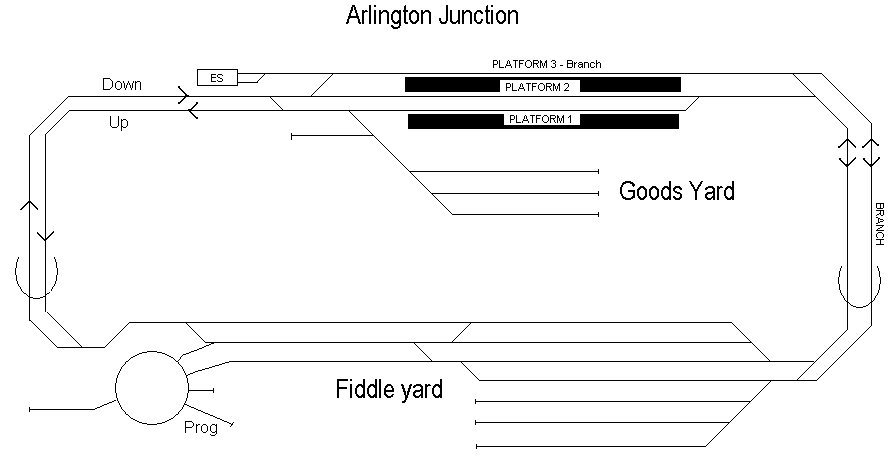
Arlington Junction, change for Toronto
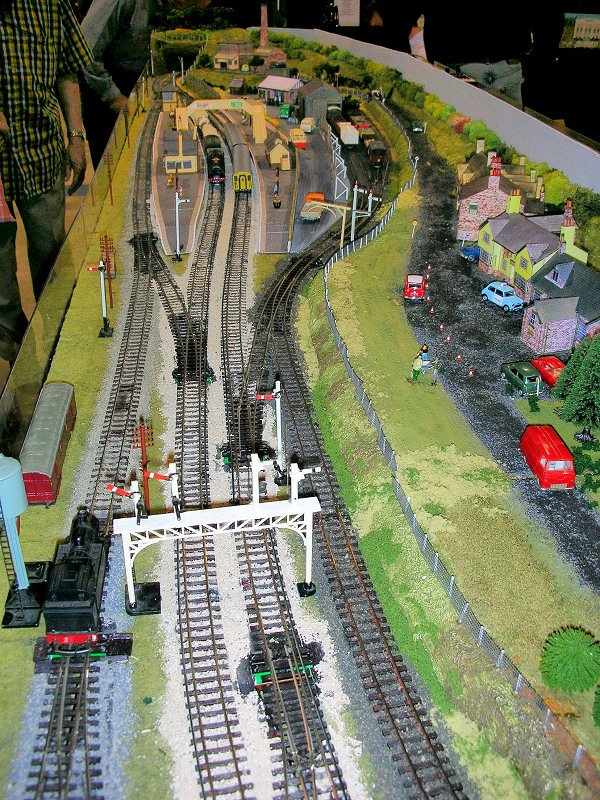
The Digitrax DCC system proved very successful in 2004, the weakest operational part of the layout being the Tri-ang points, which have a large dead frog area, and occasional intermittent blade contacts causing stalling, especially with the dmu's. The sharp radius of the Tri-ang points and curves was also a contributing factor in the unacceptable performance of the rolling stock, and a conclusion was reached that the track for the next layout had to be of a much higher standard. To see the full report on the 2004 show, click HERE
For 2006, several brands of 12mm track were investigated, including Tillig and Peco. Peco HOm track was chosen, but it's really designed for modern narrow gauge stock, such as Bemo with finescale wheels. Consequently, the point crossings and check rails are much too fine for the coarser Tri-ang wheels, so each point had to be modified to increase these clearances by judicious application of a rotary grinding wheel in a hand held power tool. Some loco flanges needed reducing, and some of the coarser plastic wheel flanges could be heard bumping along the chairs, but a plan is in hand to re-wheel all of the rolling stock with metal pinpoint wheels, and add extra pickups where possible to motive power.
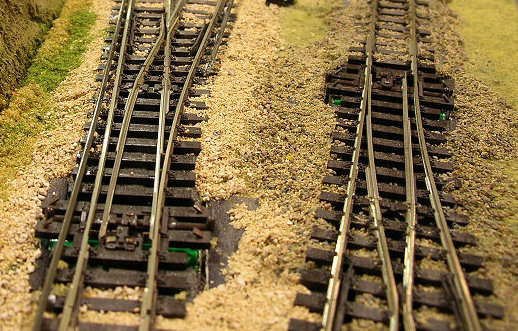
The curved points are DCC ready, the straight points needed two extra isolation breaks, this is to enable the point blades to have the correct rail polarity at all times. Peco point motors were used mounted under the baseboard surface, with their own accessory switch for changing the live frog polarity. As in 04, the points were all operated by dcc commands. To reduce the button pressing required for setting up train paths, a form of routing was proposed, so a new Digitrax DCS100 command station was obtained, the two Zephyrs acting as boosters, giving 3 track power districts. Also, a top of the range hand held unit was acquired, this could also work remotely, either using infra red, or radio frequencies.
Unfortunately, there seemed to be a glitch in the routing software, and for the show it was decided to retain individual point switching. Another proposal was for computer control of the routing using commercially available software, with computer screens showing the routes set, but again, time was the enemy. Perhaps for 2008?
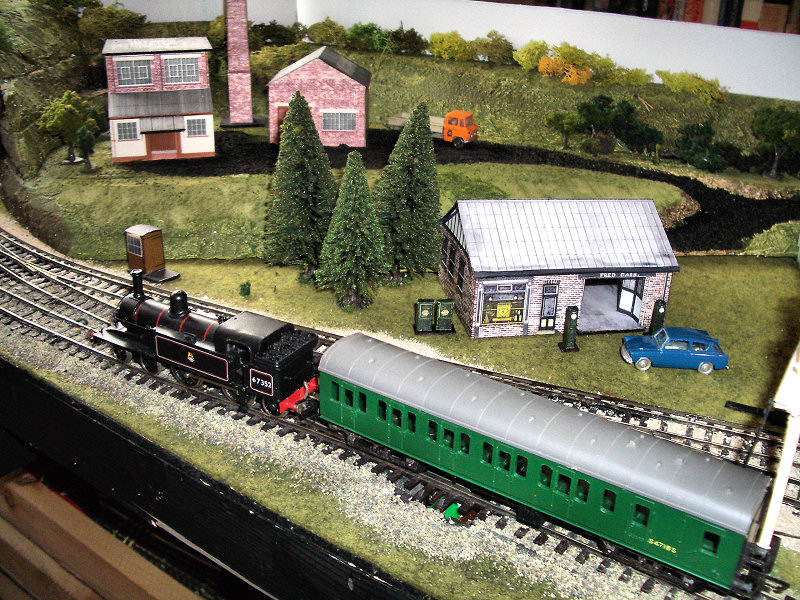
By using nickel silver track, the Tri-ang magnadhesion effect had been lost, but as the curves were much larger radius, it was found that train lengths were the same as before when using steel rail. When the stock has been fitted with replacement free running wheels, maximum train lengths should then be greater than standard Triang. The third rail was N gauge rail, glued to white rod which represents the porcelain insulators, and was non operational, but looked very good. The scenery was built on foam boards, with Woodland Scenics colouring and foliage. The buildings were mainly constructed from old Bilt Eezi kits from the 1960's, around a balsa wood shell, the platforms being modern OO Metcalf kit reduced in height, which looks contemporary with the village structures designed 40 years ago.
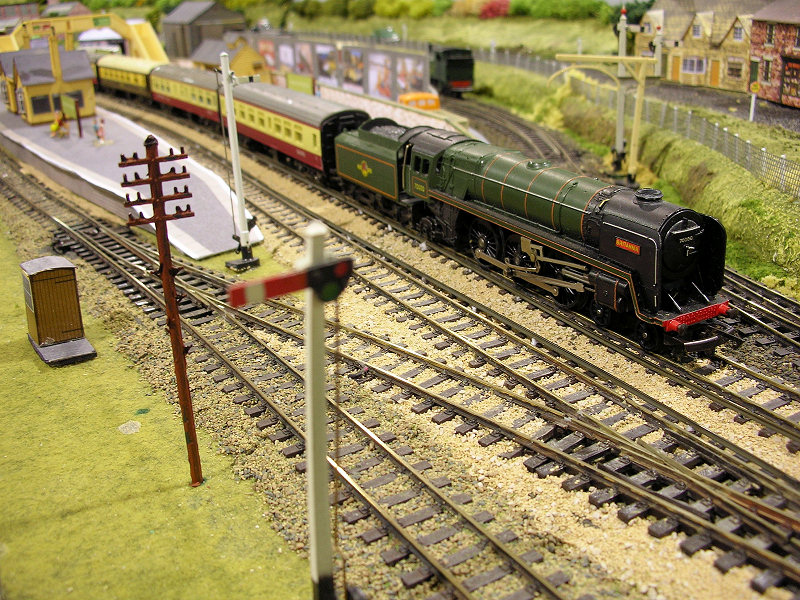
The layout is described as 'A heritage TT scale featuring vintage 1960's rolling stock and building kits with some custom built modern additions.
Third rail electrification of the mainline has just reached Arlington Junction, but the branch line to the seaside is still not electrified, and beyond Arlington the main line is down to single track, thanks to Dr Beeching. Engineering works on nearby lines can cause surprising diversions through this south Sussex rural station. The layout comes from Arlington, Virginia, thus the name.'
As in previous visits, I have used the few days after my US arrival before the show to service the loco fleet, and sort out any minor problems. John had commissioned some kit built locos, which had been made for conventional dc, but were very easy to convert to dcc operation. A 4 car BEP unit and an ex LNER C12 ( what's that doing on a Southern Region layout? ) had Digitrax DZ123 decoders fitted, as well as some 1960's K's and Gem cast whitemetal body kits fitted to 060 chassis. The extra weight made these the most reliable haulers of all the motive power.
However, one day was reserved for the York Pennsylvania Train Collectors Association spring meet, around 3000 traders selling nothing but toy trains to over 14000 visitors. Unfortunately, John couldn't make it for business reasons, so I ventured out alone, 240 miles in a car I had never been in before, let alone driven. Luckily, I made the return journey without incident. If you're a collector of tinplate O gauge American outline, then you MUST visit York at least once, almost everything is available, from 1920's Lionel standard gauge, to 21st century current production, with fantastic sound, smoke and other features. As I'm a Tri-ang OO collector, you might think that there wouldn't be anything of interest. On previous visits, Tri-ang 'made for North America' items have been purchased, but none were spotted this time. Some common UK items were for sale, at non-UK prices. Other UK OO spotted included Mainline, Trix , Hornby, Airfix, Wrenn and Dublo. Even a Graham Farish die cast wagon, and a very poor Hugar bridge. A few items of Hornby O, and modern ACE and Basset Lowke. I did manage to buy at 'blowout' prices some nice G scale items, a GP9 BoBo diesel, a large caboose and a flat wagon with cars. Also, a working level crossing with flashing lights and a warning bell. Packing the case for the flight home was fun! My tip - take the large items apart, and fill them up with other things, the caboose contained the crossing barriers and a couple of items purchased in Toronto, and some Kadee couplers bought for a friend in the UK.
‘Any make, Any gauge, Any age’
TCS©2009