 The
Train Collectors Society
The
Train Collectors Society
‘Any make, Any gauge, Any age’


|
‘Any make, Any gauge, Any age’
|
|
The Journal of the Society is the TCS News, published quarterly, and sent to all members. This regularly includes reports of train shows. Report by Malcolm Pugh on the2004
Toronto Great British Train Show
TCS news contains an
exciting mix of articles, layouts, restoration tips and show reports. Mostly,
these reports are from UK shows, but this is
a show report from the Bi-annual
Great British Train Show held in Toronto 2004. TCS news has reported
on this show since 1998 - this 2004 show report is exclusive to the TCS website.
Unfortunately, for obvious reasons, the names of the collectors involved have
been removed. The toy train
collecting world is a friendly one (mostly), chat to your neighbour in a queue
for a toyfair admission, and the time soon passes. Over the years I've made good
friends with train collectors in Australia, America, Canada and Europe. Since
1998 I had been corresponding with a collector from the Eastern coast USA,
mainly about Tri-ang OO. We had sent each other models, I sent some UK style
Tri-ang, and I received some Tri-ang
exported to USA and Canada. My friend is of British origin, and had Tri-ang OO
as a child, which accompanied him around Europe as his father was in the RAF.
But now he's lived in the USA for many years, and is an American citizen. We first met up in
late 1999, when asked if I would
assist at the bi-annual Great British Train Show in Toronto organised by the
Platelayers Society the following April. So April 2000 saw us in Toronto
exhibiting a Tri-ang OO layout 18 x 7 ft using
his original series 3 track. Then shortly after, he got the Tri-ang TT
bug, and April 2002 saw us running a similar sized TT layout.
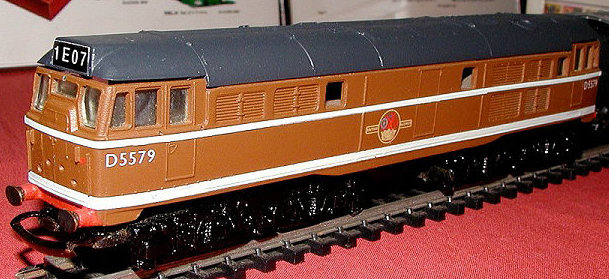
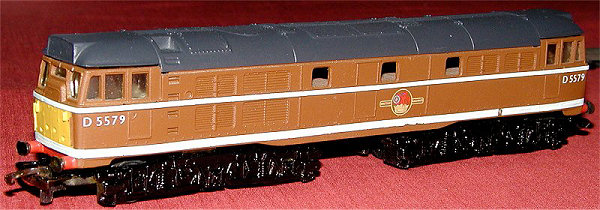
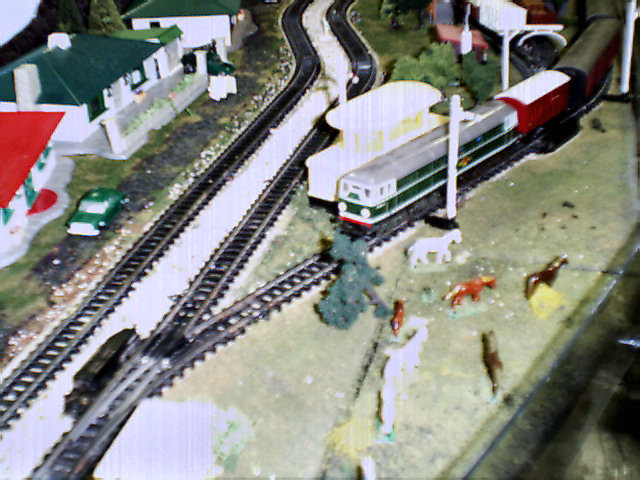
The golden ochre class 31 really did exist. In the 1960's, experiments were conducted as to the best colour to paint diesel and electric locos for maximum lineside visibility. One colour tried out was golden ochre, applied to one class 31, and some Westerns. To make the TT version, a headcode box has to be added to the roof moulding and the headcode discs removed from the loco front. Footsteps and handrails need adding to the front.
The loco is pictured here with the varnish just about dry - the cab handrails have not been re-attached, and the glazing and battery box are missing. Currently ( 2004 ), the Great Central Railway have painted one of their real class 31's in golden ochre. And yes, one end of the loco has a yellow half warning panel, the other is plain!
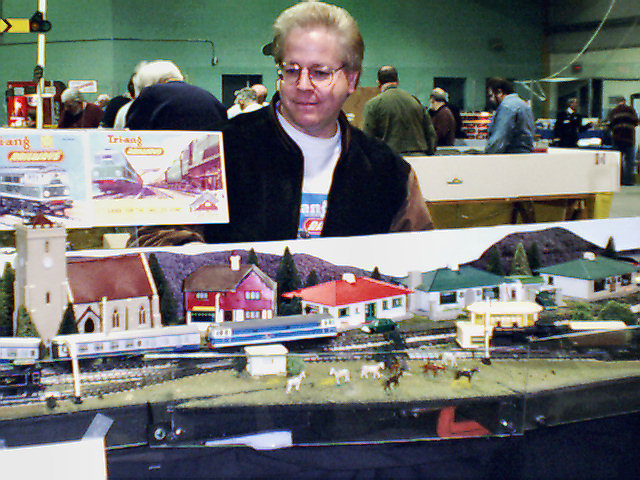
The chap shown is a Canadian Tri-ang enthusiast who helped setup the layout and operate the first day. The blue A1A and coaches are shown here. These were repainted for the 2002 show. The blue A1A was a Tri-ang model made in France in VERY small quantities, and is extremely rare. This model is a straightforward repaint of the body, care was taken to renumber it differently from the real model.
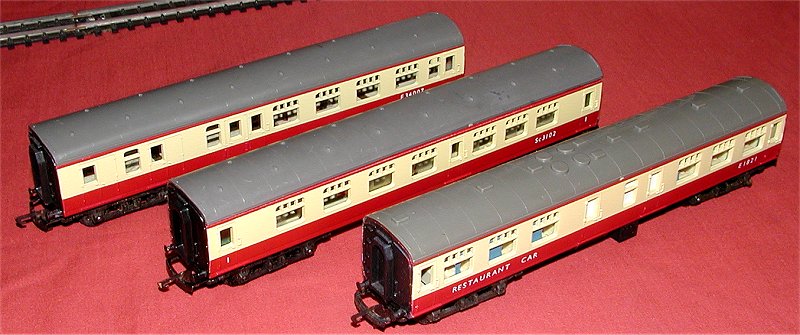
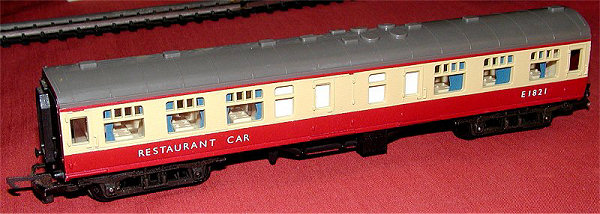
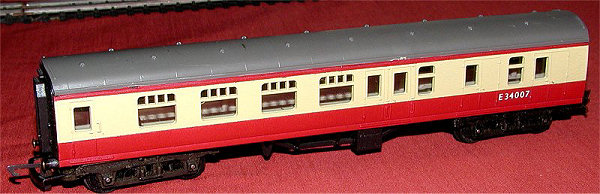
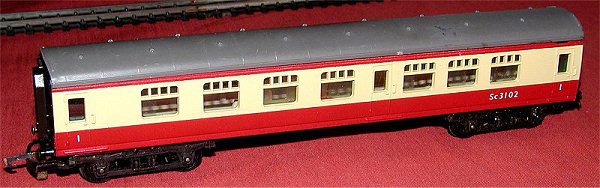
The blood and custard coaches were a fairly easy but time consuming job, as Tri-ang never did any coaches for the Scottish or Eastern regions, care was taken to ensure that the numbering was reasonably accurate, to avoid those embarrassing moments at shows: 'that coach number is wrong!'
Restaurant car in 'blood & custard'
Brake composite for the Eastern Region
First class for Scotland Thanks to Dave McCarthy for all the above excellent close up photographs
The following day a
family trip took us to Randolph-Macon college in Ashland, Virginia, to his son's
entry into the Virginia State Science and Engineering fair. They had made
another working maglev about 4 feet long, this time with improved mechanics and
electronics, which won second place with a $75 prize. Running down the main
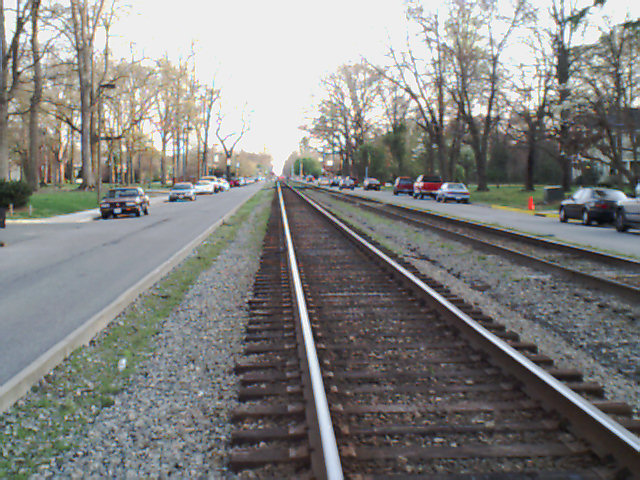
street of the town and adjacent to the college
is the unfenced double track main line from Washington to Florida.
Passenger and long freight trains were passing
through at about 40 mph, admittedly with lights flashing and horns blaring. What
would the Health and Safety executive have to say about that? Although the grade
( level ) crossings do have full length barriers! Unfortunately the trains were
rather unpredictable, so the photo shows the main line without a train in sight.
Ashland I had also been
corresponding with another collector from America, and his information about US
O scale command control was included in an article I wrote for TCS news. He also
invited me to drop by and see his layouts, as the distance wasn't too great, we
went to have a look. He has a typical US style HO layout in his basement, around
20 x 20ft ft at chest level with walk in and duck under operating areas with
many features including a large roundhouse with turntable, a town scene, tunnels
and various industries requiring shunting, or switching as it's called there. He
has recently converted to DCC control, but the tortoise motored switches, or
points as we would say, were still conventionally controlled. A steam loco with
digital sound was demonstrated, very impressive. Also in his basement is a
smaller Lionel O layout about 10 ft
square, representative of items he had in his childhood, this has Lionels TMCC
control. For the 2002 GBTS,
the first TT layout used modified OO boards from 2000. A great deal of time was
spent wiring power sections and point motor feeds in the conventional way. After
the exhibition, the layout was intended to be set up again at home, but for
various reasons was never used again, so all the wiring effort was wasted. As mentioned earlier,
the maglev project had taken a considerable amount of time, so it was only just
in early 2004 that all the track was finally in position, and ready to be wired
up. The thought of many hours wiring, for it not to be used again after the
show, was unthinkable, so the
radical decision to go down the DCC route was taken, both for traction and for
point control. Only two wires required! Wiring in the point motors was easy,
just connect the solenoid coils to the output terminals of a DCC point module.
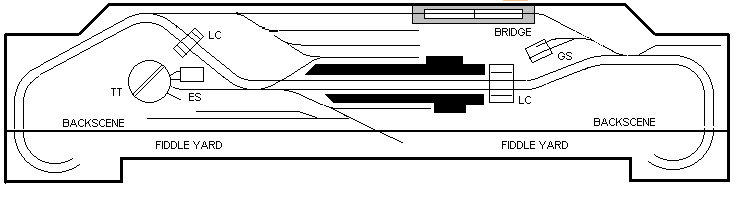
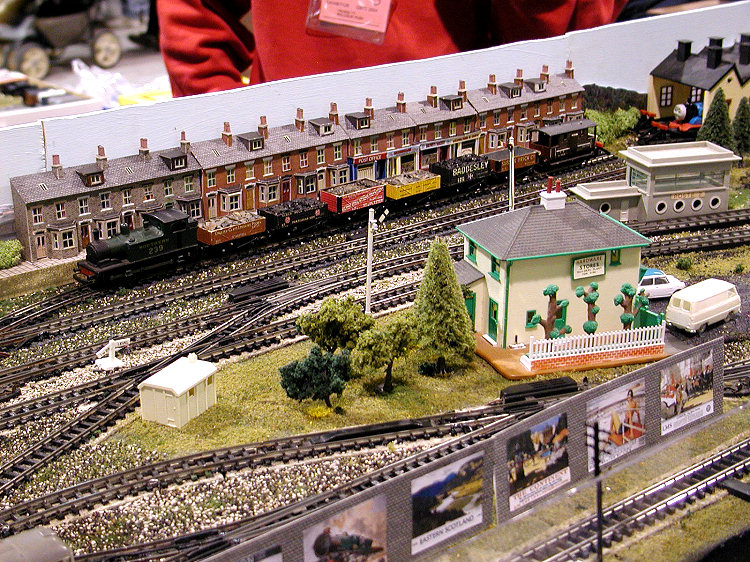
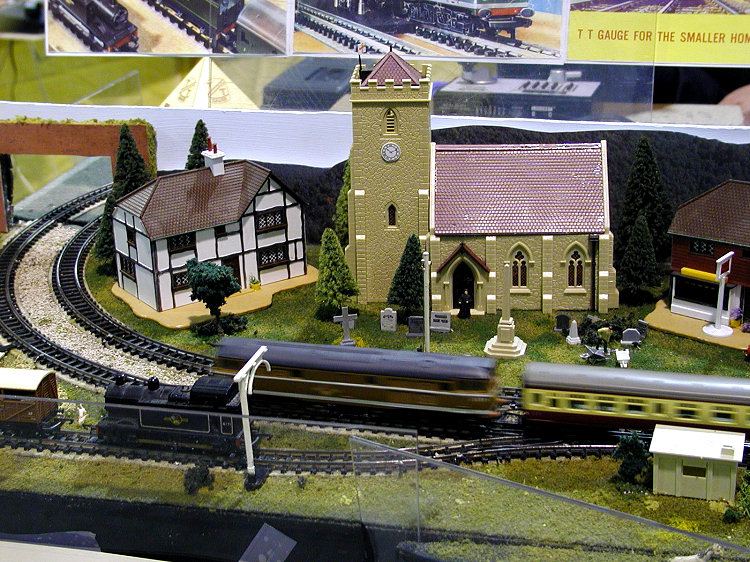
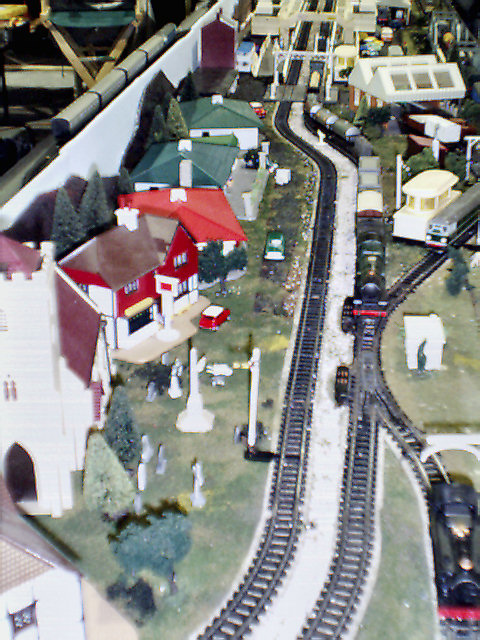
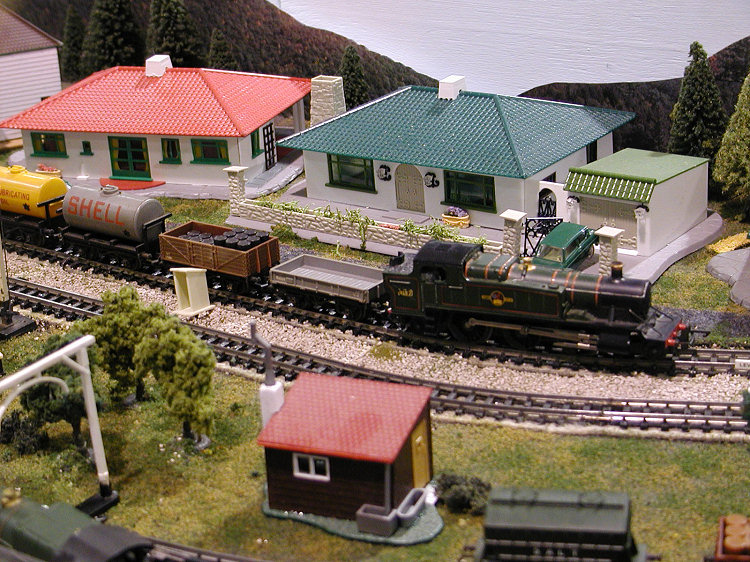
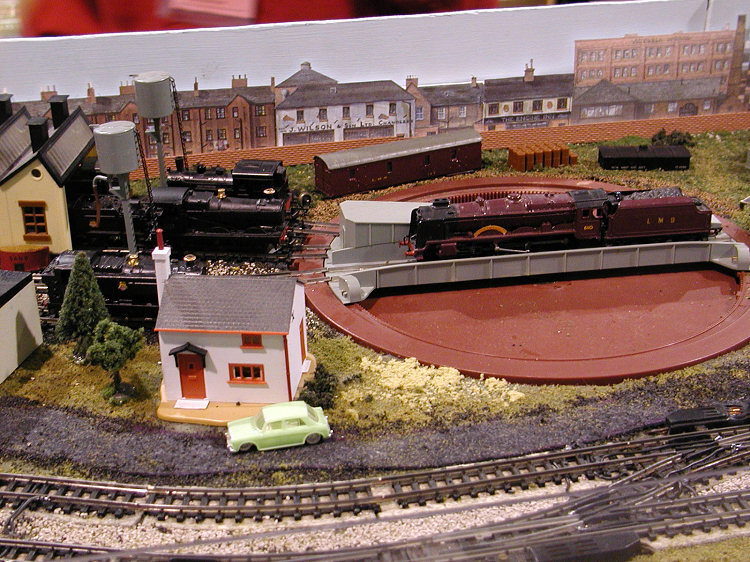
No layout sectioning is required. The track used was original Triang TT type B, most of the railway buildings were from the Triang TT range, the townscape being Triang Modelland. N gauge backscenes were used to force the perspective, making the layout look deeper than it really was.
The trackplan Time to learn about
Digitrax DCC. Two identical units had been obtained, Digitrax DCS50's ( also
known as the Zephyr), which can be configured either as a master or booster.
Each unit has a direction and speed control, along with a keypad and LCD
display. The output power from each unit is 2.5 amps which would be enough to
run 2 or 3 TT locomotives simultaneously, but not possibly not 4 or 5. So the
layout was split into two power districts, the front scenic section, and the
rear fiddle yard. The two units control system are linked together onto the 'Loconet'
bus, also two hand held controllers are connected. The main units can address up
to 9999 locos, but the handheld have two rotary decade switches, so only locos
up to address 99 can easily be
called up. Each DCS50 has a 10 address memory, so even with one unit, up to 10
trains can be run simultaneously, although only 1 is under direct control.
Points are controlled from the DCS50's, also the master unit has the programming
track attached. Every loco has a Digitrax DZ123 chip fitted, the steam locos
being the easiest to convert, for the 060 tank loco, the chip fits in the
sidetank area, for the larger locos into the boiler space. The diesel shunter
can be treated like the steam 060 chassis, but the two other diesels, the dmu
and A1A are more difficult. They both have an integral power bogie, which
requires permanent non reversible modifications to insulate the brushes from the
wheels. The spur from some stabling sidings actually enters the fiddle yard.
This creates a short circuit, but by isolating this short section, and feeding
it through a Digitrax reverse loop module, the correct polarity is switched
automatically. After 3 days of playing around with final testing, adding extra
track feeders to overcome some voltage drop, tweaking the rolling stock for
best running qualities, it was time to pack the layout up into the SUV,
or Jeep to me, for the 600 mile journey north to Toronto. En route, we visited
a railroad museum in Altoona Pennsylvannia. In steam days this used to be
a total railway town, where locos were made, overhauled
and serviced, freight cars repaired, and technical research conducted, I
suppose much like Swindow, Crewe, or Doncaster used to be. The museum is
fascinating and merits at least 2 to 3 hour visit, but the external exhibits
were showing signs of decay, a wooden box car being in particulary poor
condition. Then and still today,
banking locomotives are attached for the fearsome climb over the Allegheny
hills, alongside the museum is the main line, we saw the rear of a train with 2
assisting 'pusher' or 'helper' locos screaming away at full power moving just
faster than walking pace. A few miles down the
road there is an awesome feature of the gradient, a horseshoe curve. A viewing
area has been constructed, and as we arrived we saw the rear of the same train,
still only moving at a running pace. One of the other visitors I was chatting
to, incidentally born near the Lickey incline, said that the head end had 4
locomotives! The sun was out, we had time to spare, so we enjoyed the view, and
we were lucky seeing some more trains, including
pushers returning to Altoona to assist another train. In the viewing area
is a preserved diesel loco, and a radio reciever loudspeaker
tuned to the loco cab chat fequency. Some interesting messages were
heard, we could tell another uphill train was coming as the diesel engine noise
in the cab was as loud as the crew conversation. Eventually, it appeared, two
massive road engines hauling approximately 100 empty bogie coal cars. The front
of the train dissappeared before the rear of the train could be seen! Intermodal
trains seemed to be the most common, apparently two Amtrak passenger trains run
through in the early afternoon, but we had another 300 miles to travel before
staying overnight near Niagara. We had left Washington with the spring bulbs
just about over, approaching Niagara they were just coming into bloom, and
looking at flower borders in Toronto, the stems were only just out of the
ground! Condensed information
on the Horseshoe curve: Built by hand in 1854, originally 2 tracks, then 4, but
now 3. length 2375 feet, central angle 220 degrees, width 1140 feet at widest
point, Eastern elevation 1594 feet, Western elevation 1716 feet, gradient 1.8% (
1 in 56 ) which is eased on the sharpest part of the curve. Arriving in Toronto
at the Jim Archdeakin centre, we set up the layout in the ice rink, everything
still worked much to our relief. It was also 2 layers of clothing warmer than
2002. We were staying again with another collector friend, a Londoner by birth,
who moved with his wife to Canada more than 25 years ago. In 2000 the front
lounge had a model railway, in 2002 the room had been converted into a lounge,
so for 2004 we were expecting the layout to have been rebuilt. Unfortunately,
this hasn't happened yet, but some building work has been completed in the
basement ready for layout reconstruction. Having cleaned the
rails before the show started, we didn't have to clean them again for the two
days of the show. We put this down to the high continuous voltage of DCC. Other
benefits were that running was much better without voltage drop effects, which
are quite prevalent when using vintage sectional track. It seems to be much
easier to operate a DCC layout than a conventional dc layout. Whilst sitting in
a high stool, with controller to hand, each train can be called up, points set,
and trains run anywhere without having to worry about isolation switches. By not
having to think about electrics, more time can be spent enjoying the trains.
Double heading is easy too, the loco characteristics can be modified to be
almost identical, which makes long trains possible. If we concentrated,
we found that we could each run 2 trains directly on each circuit, one on the
DCS50, and one on the handheld,, and by using the DCS50's memory, a third train,
but then we would be distracted by an observation or question from a show
visitor, and then one train would catch up with another with consequent
derailment.
Other vintage layouts
were provided by the Toronto Hornby group, showing an improved and extended 3
rail layout, and a Trix Twin layout using bakelite track. I should have spent
more time admiring them, which also
goes for all the other layouts. There were many model layouts from N to 1
encompassing most aspects of the British scene, and a Lionel G scale train set
for 'junior'. These trains are much more exciting than the OO Hornby range, as
the faces on the locos are so much bigger. Also, the eyes are driven by the
motor, and the faces are interchangeable. It's a shame they only made Thomas and
James, and some rather short coaches and basic wagons. There were plenty of
traders selling British outline, new and used, along with kits and general bits
and pieces. Much like any model show in the UK! The club bring and buy stall had
a wide mix of second hand items for sale, ranging from intricate made-up kits to
rather dilapidated ancient rolling stock. One or two items were purchased,
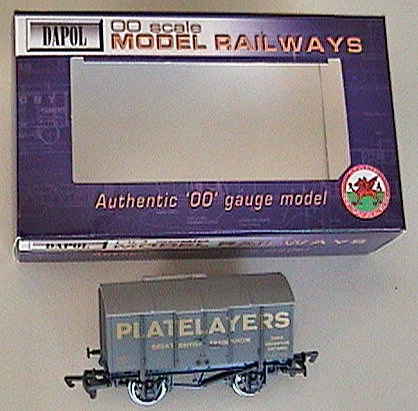
including a long term want which can now be crossed of the list. For 2002, the
platelayers had commissioned a special wagon from Dapol, this was a 7 plank open.
A few bodies were available as spares from their Llangollen factory until
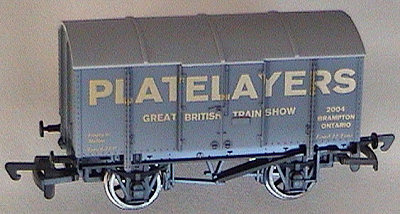
recently. For 2004, they had commissioned an ex-GWR iron mink van - which only
just made it to the show, apparently they were held up by Canadian customs.
So it was another
intensive train weekend, all we saw of Canada was the inside of a sports hall,
the inside of two houses, and the inside of three bars! In 2000 and 2002 we
really were tourists, as we had time to see Niagara falls and downtown Toronto,
but not this time. A pleasant if long drive back to Washington, then a serious
attempt at packing all my acquisitions, but I had to admit defeat and send some
trains back by post. On returning to
England, as we dropped through the clouds, my first sight of home was of Windsor
Castle, no, not the TT locomotive, but where HMQ occasionally resides. horseshoe curve: platelayers:
http://www.theplatelayers.org/ Altoona:
http://www.railroadcity.com/rrm/index.php
with links to horseshoe curve webcam
|
|
|