 The
Train Collectors Society
The
Train Collectors Society
‘Any make, Any gauge, Any age’



TOP SHED
Malcolm Pugh's 2nd. update ..... February 2008
The
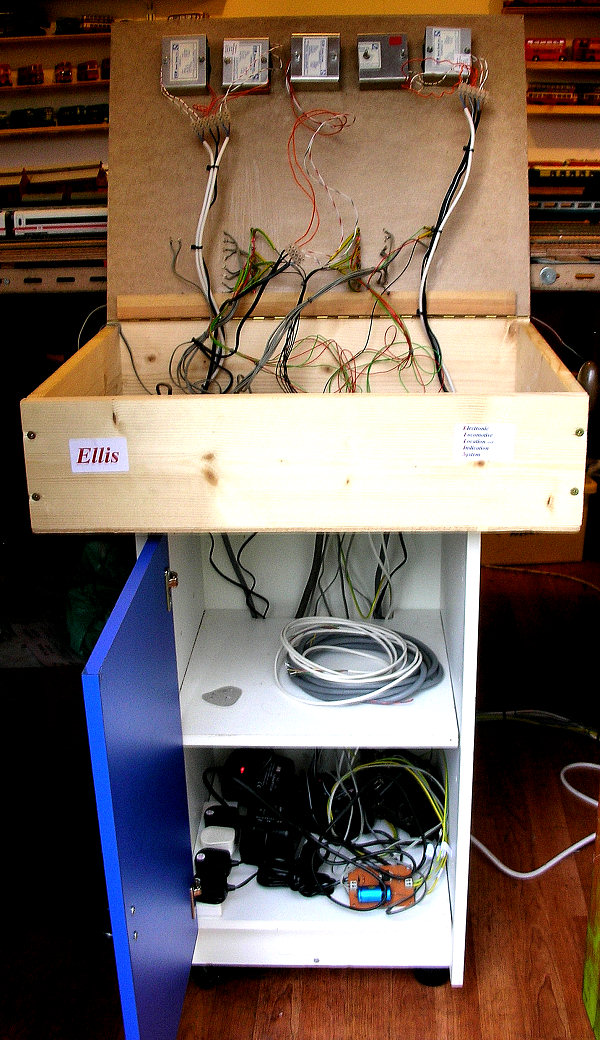
bedside cabinet, that forms the base of the controller, was called Ellis in the IKEA catalogue, the name has
since stuck, and near neighbour ex MET Office weather forecaster Suzanne
Charlton, who presented the weather on BBC TV, has devised the
term
"Electronic Locomotive and Location Indicating System".
Her son
enjoys running the layout, at home he has a slightly smaller layout.
Construction of the control panel has been very time consuming, with little
visible evidence of progress for quite some time. Perhaps it would be better
to make the control panel BEFORE making the layout. Next time!
'ELLIS'
Electronic Locomotive and Location Indicating System
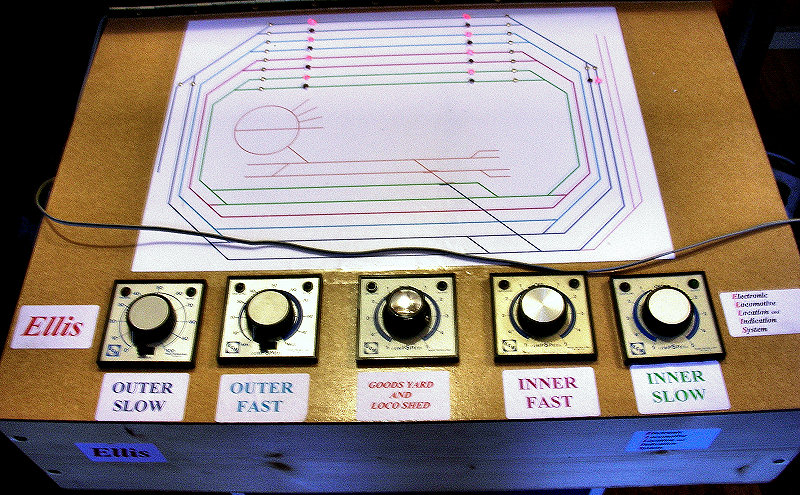
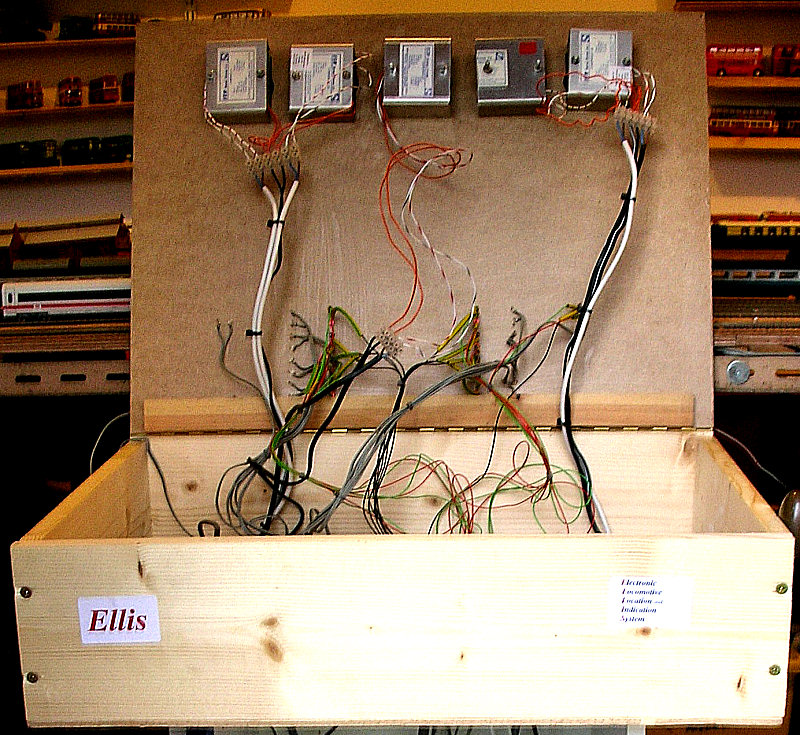
Ellis was made with a hinged lid for easy access to the controllers and wiring. Peco studs are located on a coloured diagrammatic plan of the layout to operate the points and (not yet fitted) toggle switches for platform isolation sections. The mains transformers are on the bottom shelf, making the unit stable. There are 3 Maplin 12 volts 3 amp units, unless they are fully loaded, their output voltage is almost 15 volts, ideal for the Compspeeds. Also, a slightly reduced input voltage gives a much more realistic maximum speed.....after all, this is a model railway not a toy train racing set! The clockwise and anticlockwise circuits each share a Maplin unit, the yard is fed from the third, and we'll use this AC to feed the terminus station controller which will have it's own control position. There is also a Hornby transformer for AC auxiliaries, including the capacitive discharge unit for the points, two feeds for power switching circuits, and one to power the point position LED's. The power to operate the turntable will also be taken from here.
Most of
the track power switching is by the self isolating properties of the Peco Insulfrog points. However, there are areas where more complex power switching
is required, and this is done by double pole relays, each operated by key
points. One point leading across the 4 diamond crossings switches power to the
double slip from the inner slow via the loop entry and exit point, to outer
slow controller, and a second units switches yard power from the yard
controller to whatever power is fed to the double slip. Hence travelling from
the outer slow into the yard, with the points correctly set, is all on
one controller. Re-setting the points restores yard power back, and re-setting
the 'diamond route' restores the inner loop power back to the double
slip.
The wire seen trailing across Ellis is the wander lead for operating the
points by means of the Peco studs. The LED's indicate the position of the
points on the far side as their position is hard to discern from the operating
position. Point detection is by microswitches operated by the point tie bar.
The front points will eventually be motorised and have their respective studs
fitted. It is planned to use the new Peco PL11 slim line motors, possibly the
similar new Hornby ones may also be suitable ( and cheaper! )
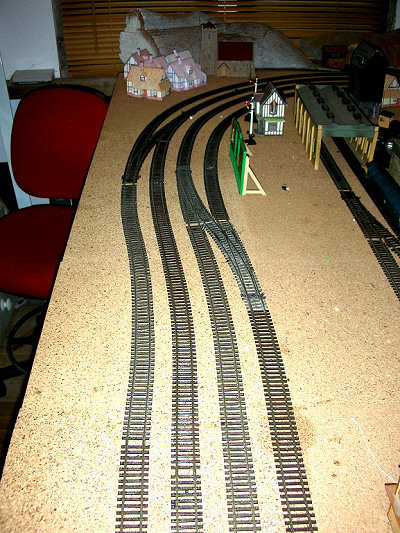
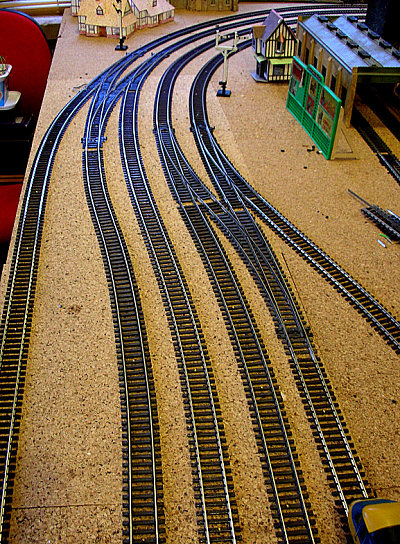
It is apparent that the layouts owner prefers running trains round, rather
than extended shunting, so with the temporary electrics removed, with the
addition of just two points, and by extending the bay and loco spur lines, two
extra platform loop lines have been installed. Whether by accident or design,
the curve radius at the (future) terminal station end was exactly the same
as Peco curved radius points, enabling their insertion without spoiling the
appearance of the smoothly flowing trackwork. The inner loop will also enable
anticlockwise running trains to be returned to the future terminus, an
oversight in the original design. This was realised before construction of the
control panel, so the extra lines were added on Ellis' trackplan before they
actually existed on the layout.
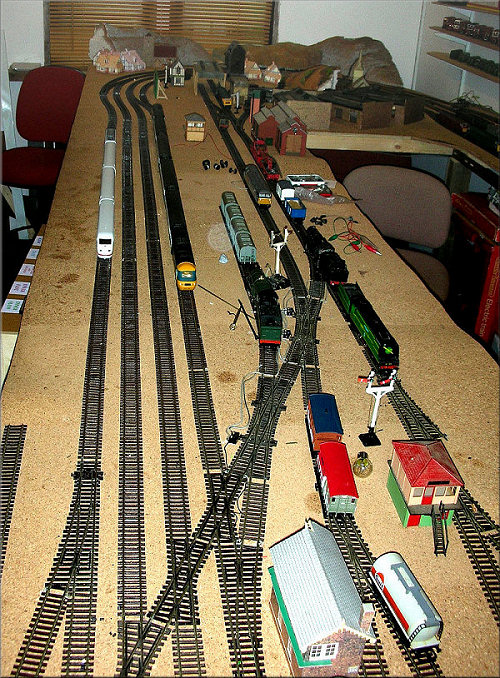
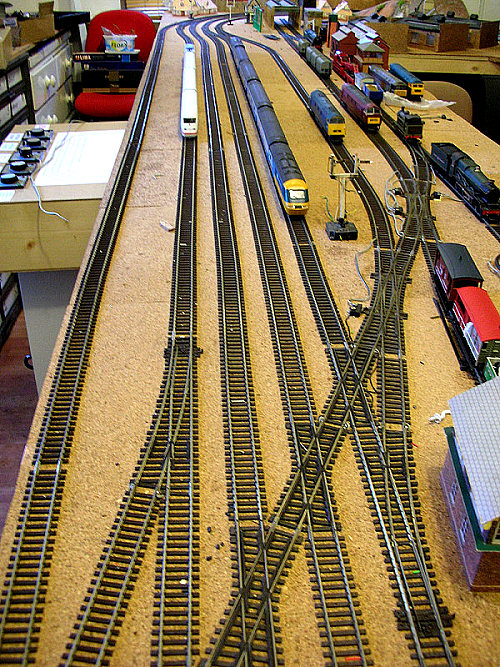
This really completes the major trackwork on the main running lines, the next
jobs are to extend the baseboard for the terminus station, lay the track, and
to make platforms for both stations.
To be continued.......................
‘Any make, Any gauge, Any age’
TCS©2009