|
The Journal of the Society is the TCS
News, published quarterly, and sent to all members. From time to time we will
include the odd extract from the magazine on the site to let non-member know
what they might be missing!
Remembrance
of Things Past, Part Two –
S-scale
Trains Made in Weimar
By
Dirk Hertel
TCS 694
My article
“Remembrance of Things Past – O-gauge Trains Made in East(ern)
Germany
” [1
] briefly mentioned VEB Metallspielwaren Weimar as the third East German
manufacturer of larger-than-HO trains. Although I remember their S-gauge
clockwork train sets being sold widely in East German toy and model train shops
from the 1960s to the end of the 1980s, I never saw any of their early O-gauge
trains. My interest was rekindled in summer 2004 when TCS members Bryan Pentland
and Dave Ramsey each sent me information about their East German O-gauge
clockwork train sets from an unknown manufacturer. I identified them as
Weimar
trains, and my subsequent publications in TCS News [2
, 3
] resulted in contacts with German collectors that have enabled me to
compile this more systematic account of
Weimar
’s S-scale trains.
VEB Metallspielwaren
Weimar, based in the Thuringian town
Weimar
, was an important East German
manufacturer of toy cars, lorries, and clockwork trains. Andreas Reißmann [4
], the proprietor of the newly established DDR-Spielzeugmuseum (
GDR
Toy
Museum
) in Langenwetzendorf near Greiz (www.spielzeugmuseum.lunalight.de),
provided an account of the firm’s history as well as its different logos. Its
predecessor “Metallwaren Galvanik Weimar” had started production in the
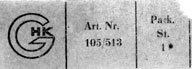
1950s, and in 1958 issued a series of clockwork trains with the box label GHK (G
stands for “Galvanik”, HK are probably the initials of the firm’s owner).
These first trains were approximately S-scale, but run on O-gauge track. After
nationalisation in 1960 the firm became VEB (K) Metallspielwaren Weimar (VEB (K)
= district-owned factory, 'Metallspielwaren' = metal toys), often referred to by
the acronym MSW. Their new logo was a small electric motor in front of a
clockwork key. From 1964 O-gauge trains were phased out in favour of S-gauge.
Neither GHK nor MSW labelled their trains, but from 1975 the letters ‘grip’
appeared on some batches of rolling stock. When MSW was renamed “VEB
Spielwaren-Mechanik” in 1982, ‘grip’ became the new logo. The absence of
an identifiable trademark was possibly a concession to exports across the Iron
Curtain.
|
|
|

|
|
Logo ‘GHK’
of the Metallwaren Galvanik Weimar (Bryan Pentland collection).
|
Logo of the VEB
Metallspielwaren Weimar, used from 1961 (
GDR
Toy
Museum
).
|
Logo ‘grip’
of the VEB Spielwaren-Mechanik Weimar, from 1982 (
GDR
Toy
Museum
).
|
Early S-scale went O-gauge
When Bryan Pentland
and Dave Ramsey asked for my help in identifying their boxed train sets, with
the help of some German collectors we established that they were Metallwaren
Galvanik Weimar’s early O-gauge trains.
Weimar
seems to have offered their O-gauge
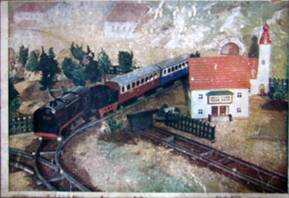
trains only as boxed sets. The box lids were decorated with attractive pictures
showing different train configurations and scenery with typical
Erzgebirge
(
Ore
Mountains
) wooden buildings. Some of the boxes are still labelled with the logo
‘GHK’, identifying the manufacturer as “Metallwaren Galvanik Weimar”.
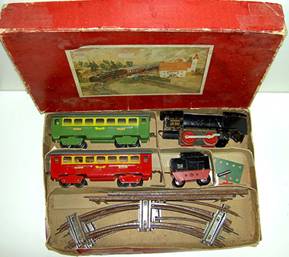
The sets came with
two different clockwork 0-4-0 steam locomotives and tender:
-
The most common one was of
sheet metal construction, and its cab bore the transfers ‘Deutsche Reichsbahn
BR 64 002’ and ‘Pt 35.385’. The boiler had one dome and three embossed
steam pipes, handrails and large smoke deflectors. The locomotive had red
plastic wheels, and the piston rods, simple pieces of sheet metal, were
connected to the rear driving wheels that were fitted with rubber traction
tires. The 4-wheel tenders had embossed rivets and were lettered “DR”
(acronym of the Deutsche Reichsbahn). A row of 3 round holes at the red base was
their most distinguishing feature.
-
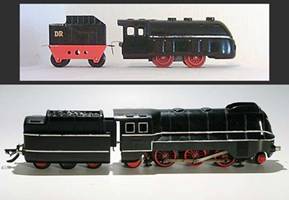
A second, much harder to
find, locomotive was modelled after the popular FD-50 “Borsig” streamliner
and came with a Bakelite shell that resembles that of the larger Zeuke 2-6-2 and
4-6-0’s; therefore it is occasionally mistaken for Zeuke. The locomotive looks
somewhat peculiar because the typical
Weimar
tinplate tender does not fit its Bakelite
streamline design. However Andreas Reißmann (
GDR
Toy
Museum
) and www.DDRtete.de
[5
] confirmed its authenticity.
Weimar
offered the above locomotives with four
different train configurations:
-
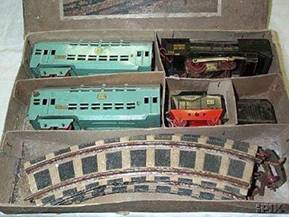
An articulated pair of
second-class double-decker bogie coaches with corridor connection, enamelled in
aquamarine, green or red. They had transfers “DR” and “Nichtraucher”
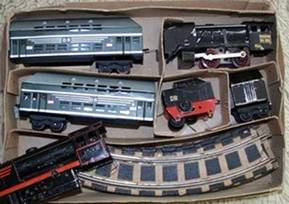
(non-smoker). There was even a deluxe version in the correct DR livery – dark
green with white lines.
-
A pair of simple bogie
coaches enamelled in a two-tone livery of red, green or blue with ivory above
the sill level, decorated with the “Flügelrad”
(winged wheel) symbol of the DR and transfers “Nichtraucher”. The less
common blue-ivory version is shown on one of the box lid pictures.
-
A pair of 4-wheel open
platform passenger coaches enamelled in red or green with yellow window frames,
decorated with transfers “Nichtraucher”.
-
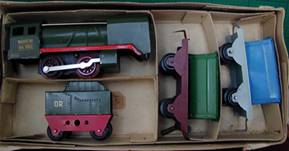
A pair of simple 4-wheel
tipper wagons.
|
|
|
|
BR64
double-decker clockwork set, S-scale with O-gauge track (Bryan Pentland
collection).
|
The
Weimar
double-decker set in the correct
dark-green DR livery.
|
|
|
|
|
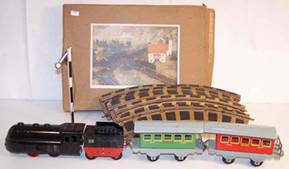
GHK Weimar
“Borsig” boxed passenger set (Michael Körber Tintoy-World,
Germany
, www.altesblechspielzeug-online.de).
|
|
|
|
Weimar
passenger clockwork set with
O-gauge tinplate track (Dave Ramsey collection).
|
GHK Weimar
boxed BR64 tipper set (Bryan Pentland collection).
|
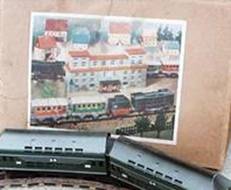
O-gauge track
included with the boxed sets was either realistic looking track sections on a
bed of cardboard with embossed colour-printed sleepers and ballast, or
conventional tinplate track complete with a Y-switch and a buffer stop as shown
in one of the box lid pictures.
|
|
|
|
Box lid picture
with BR64 and bogie coaches in red- and blue-ivory livery on tinplate
track (Dave Ramsey collection).
|
Box lid picture
of the
Weimar
double-decker set, showing the BR64
with the 4-wheel coaches.
|
However in relation
to the track, all the locomotives and coaches appear significantly smaller than
O-scale, almost S-scale, not unlike Hornby M-Series, Hachette, Brimtoy or Mettoy
trains. Train collector Hans-Peter Waak of
Dresden
,
Germany
, tried to explain the incongruity of
scale and gauge in
Weimar
’s early trains: “Originally intended
for S-scale, they were sold after having been re-gauged to run on O-gauge track.
Perhaps poor initial sales of the new S-gauge induced
Weimar
to re-gauge them to the more popular
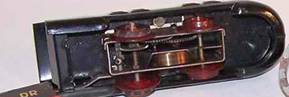
O-gauge. The gauge can be easily altered to S by pushing together the plastic
wheels.” The width of the clockwork mechanism was indeed narrow enough for
S-gauge (22.5mm), and the photos of the “Borsig” show the mechanism that
Weimar
used for both gauges S and O.
Occasionally these
trains are mistaken for products of the more prominent East-German O-gauge
manufacturers VEB Metallwarenfabrik Stadtilm or Zeuke & Wegwerth KG.
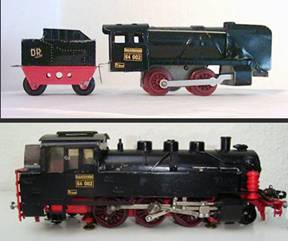
Although Weimar’s clockwork locomotives do not resemble anything made by
Stadtilm (who never ventured into the field of clockwork), it is interesting to
note that the transfers on the cab of Weimar’s BR64 are identical to those
previously used by Stadtilm on its 2-6-2 tank locomotive before their O-gauge
production was sold to Zeuke in 1955. It seems that Metallwaren Galvanik Weimar
made good use of leftover transfers. While
Weimar
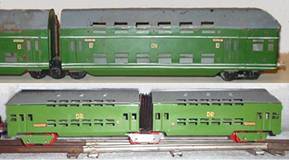
’s double-decker coaches bear some
resemblance to those made by Stadtilm in both O and S-gauges, closer examination
reveals distinctive differences in the arrangement and proportions of the
windows. Furthermore Stadtilm’s S-gauge sets always consisted of three
articulated double-decker coaches that unlike
Weimar
’s two-coach sets were fitted with
buffers, axle box castings and automatic couplers.
Weimar
’s simple asymmetric couplings consisted
of a hook and fixed bracket.
|
|
|
|
Cab transfers
‘BR 64 002’ on
Weimar
0-4-0 (top,
GDR
Toy
Museum
) and Stadtilm 2-6-2T (bottom).
|
FD-50 Borsig
Bakelite O-gauge locomotives by
Weimar
(top,
GDR
Toy
Museum
) and Zeuke (bottom).
|
|
|
|
|
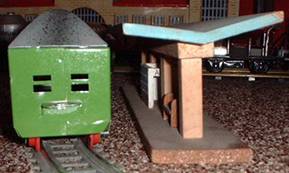
Comparison of
double-decker coaches by Stadtilm (O-scale and gauge, top), and
Weimar
(S-scale for O-gauge, bottom).
|
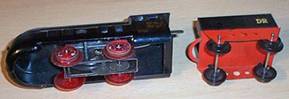
Weimar
S-scale coach with its O-gauge
wheels outside the S-gauge track (Photo by Hans-Peter Waak,
Dresden
,
Germany
).
|
|
|
|
|
“Borsig”
clockwork mechanism suitable for both, S-and O-gauge (‘DDRtete’
photo).
|
|

|
|
Display of the
GDR
Toy
Museum
, comparing
Weimar
S-scale trains on O-gauge (top)
with Stadtilm S-scale and gauge (bottom).
|
Although this
research resulted in
Weimar
being added to the list of East German
O-gauge manufacturers, their excursion into the larger gauge was only brief and
ended after 1964 with the transition to S-gauge. Without any commitment to full
O-scale these “S-scale on O-gauge” trains never became as popular as the
Zeuke and Liebmann/Stadtilm electric model train systems.
More than 30 years of S-gauge
clockwork railways
A detailed account of
Weimar
’s entire range in S (scale 1:64, gauge
22.5mm) is given in an article by Thomas Kuhlendahl, published in the
July/August 2001 issue of the now defunct German magazine “Spielzeug Antik-Revue”
[6
]. Andreas Reißmann (
GDR
Toy
Museum
), and TCS member John Forman sent me
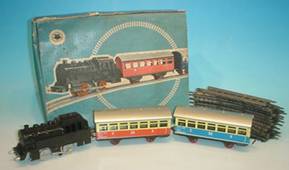
additional information and photos. Kuhlendahl started with the three earliest
S-gauge tinplate clockwork locomotives: a simple 0-4-0 steam locomotive BR 38
with tender; the BR64 002 that was almost identical to the O-gauge version; and
a steeple-cab V60. The red wheels and the use of a ‘leftover’ transfer on
the V60 suggest Metallwaren Galvanic Weimar as manufacturer of these early
locomotives. Four-wheel passenger coaches in red and green, plus low and
high-sided open wagons were offered as rolling stock, all with asymmetric
hook-bracket couplings. The track was mounted on a bed of cardboard sleepers.
After 1960 the
successor VEB Metallspielwaren Weimar (MSW) continued producing S-gauge trains,
but Kuhlendahl clearly distinguishes them from those made by VEB
Metallwarenfabrik Stadtilm (formerly Liebmann), who had started its S-gauge
production in 1956: Weimar produced only clockwork locomotives with grey plastic
wheels.
Weimar
’s rolling stock was made of heavier gauge tinplate, with more robust
enamel finish or detailed lithography. It had loosely fitted red wheels and
simple asymmetric couplings, consisting of hooks on one end and wide fixed
brackets on the other end of their vehicles. Stadtilm specialized in 2-rail DC
electric trains that were fitted with buffers and automatic couplings. Rolling
stock was decorated with transfers, and detailed casts were used for springs and
axle boxes. Furthermore, Stadtilm always labelled their rolling stock.
However, Kuhlendahl
does mention some connections between the two firms. When
Weimar
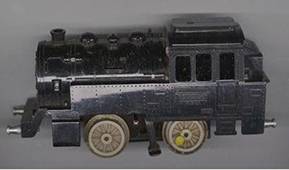
introduced the new clockwork 0-4-0 tank
engine BR80, it used the same detailed plastic shell that Stadtilm had used for
their electric model.
|
|
|
|
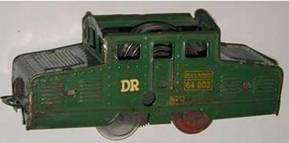
Weimar
steeple-cab V60, S-gauge clockwork
(Version with the transfer “Deutsche Reichsbahn 64 002” as used on the
steam locomotives).
|
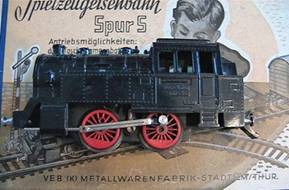
Weimar BR80
passenger set with ‘Reko’ coaches, S-gauge clockwork.
|
|
|
|
|
Stadtilm
0-4-0 BR80, S-gauge 12VDC.
|
Weimar
0-4-0 BR80, S-gauge clockwork
(piston rod missing).
|
The 1960s saw
profound changes in East German S-gauge production. In 1964 Stadtilm started
phasing out their S-gauge electric trains, and
Weimar
became the sole manufacturer of S-gauge.
Andreas Reißmann (
GDR
Toy
Museum
) points out that this coincided with
Weimar
phasing out their series of O-gauge
trains. As Kuhlendahl mentions in another article “Gauge S Toy trains from
Stadtilm” [7
],
Weimar
inherited some Stadtilm tools and technologies, but nevertheless kept
their clockwork mechanisms.
Weimar
also adopted the Stadtilm track on cardboard sleepers, but changed from
round-headed to rectangular rails that were mounted with four instead of three
tabs. A denser grade of cardboard with an increased number of sleepers was used.
Weimar
’s simple non-reversing clockwork
mechanisms were fairly powerful and were well regulated by a governor. The
stop-lever was located at the left between the wheels. The distinguishing
feature was the lack of a ratchet or ‘click-plate’ in the wind-up mechanism.
Instead its function was performed by a ‘loose’ gear wheel with elongated
bearings which allowed it to disengage from the spring wheel during winding.
Weimar
’s late 1960s S-gauge sets consisted of
the BR80 steam tank loco with two lithographed 4-wheel tinplate passenger or
goods wagons. The new type of passenger coaches, quite realistic models of the
DR ‘Reko’ series of reconstructed pre-war 4- and 6-wheel stock with corridor
connections, was lithographed in the two-tone liveries of some German secondary
railways: green, red or blue with ivory above the sill level.
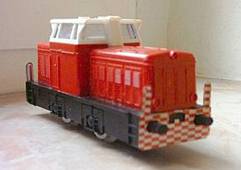
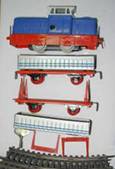
After 1970 a model of
the Czech Diesel shunting locomotive T334 started to replace the BR80, thus
reflecting DR’s increasing use of diesel. The T334 had a realistically
detailed plastic shell coloured in the prototypical red or blue, with a white
cab that even had glazed windows. The re-designed rolling stock gained improved
couplings similar to the hook couplings that Zeuke had used for their battery
trains. The passenger coaches were now lithographed in red or green with white
lines.
|
|
|
|
Diesel
shunter T334 (GDR Toy Museum).
|
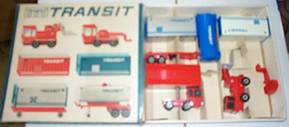
“Transit 6”
set with bulk containers.
|
|
|
|
|
Container set
“Transit 1” (‘DDRtete’ photo).
|
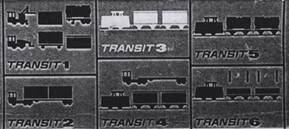
Scheme of all
six “Transit” container sets, illustration from box (John Forman
photo).
|
The 1970s saw the
launch of the container system “Transit” which represented the novel RoRo
integrated container transport system in S-gauge clockwork. In his articles
“One Man and His Trains” [8
] John Forman gave a detailed account of the entire “Transit” system.
According to a schematic illustration on the box this included six different
sets, numbered consecutively from 2118 to 2123:
-
Transit 1: Articulated
lorry, forklift truck, flatbed trailer, 3 containers and 1 tanker,
-
Transit 2: Articulated lorry
loaded with 2 containers,
-
Transit 3: Diesel locomotive
T334 and 2 platform wagons with containers,
-
Transit 4: Same as Transit
3, with the addition of an empty articulated lorry,
-
Transit 5: Diesel locomotive
T334 and 2 platform wagons with tankers,
-
Transit 6: Diesel locomotive
T334 and 2 platform wagons with open containers for bulk material.
The “Transit”
system was quite sophisticated. The lithographed metal containers came in
silver, white, red and blue, and their plastic tops could be removed for
loading. The tankers could be filled through working screw caps and were
available in yellow, labelled “Minol” or “Shell”, and in blue lettered
“Standard” or “Transit”. The forklift truck allowed the transfer of the
containers between road and rail.
I remember that all
these trains were only available in boxed sets, but unfortunately most of them
did not include any straight rail sections, and points were completely
unavailable. Anyone desiring a more interesting layout had to revert to old
Stadtilm S-gauge track.
During the 1980s the
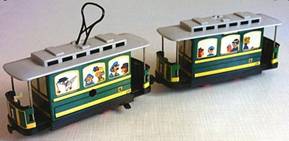
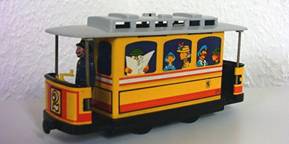
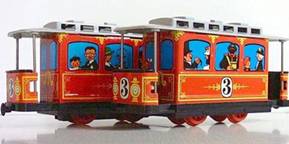
series of S-gauge trains was continued with a series of nostalgic tram sets “Trambino”.
The clockwork trams and trailers had tinprinted bodies with plastic roofs. The
trams were available in three different liveries with line numbers 1 to 3, and
the sides were labelled ‘grip’. The numbers on the boxes (2124 to 2126)
continued the numbering system of the “Transit” series. Kuhlendahl [
6
] shows pictures of set 2126 with tram No.
2. The figure of the driver standing on the open platform has often been lost,
as has the pantograph. The colourful lithography included a charming depiction
of passengers, including one reading the newspaper and another holding a
birdcage, together with moustachioed conductors.
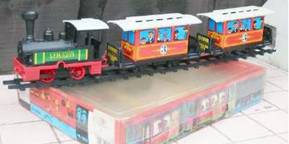
In the 1980s another
East-German toy manufacturer, VEB Anker-Mechanik Eisfeld, entered the field of
S-gauge with their “Ankerbahn”, offering several nostalgic clockwork steam
train sets in mixed tinplate-plastic construction on plastic rails. The box
numbers start with 2127, and the tinprinted sides of the passenger coaches bear
close resemblance to those of the “Trambino” trams. This suggests a close
connection between Eisfeld and
Weimar
.
|
|
|
|
S-gauge set
“Trambino” with tram No. 1 in a historic livery with the crest of the
city of
Leipzig
(
GDR
Toy
Museum
).
|
S-gauge set
2126 “Trambino” with tram No. 2 in a historic livery with the crest of
the city of
Dresden
(
GDR
Toy
Museum
).
|
|
|
|
|
S-gauge set
“Trambino” with tram No. 3 in a nostalgic red livery (
GDR
Toy
Museum
).
|
S-gauge
Ankerbahn set “Vulcan”, with coaches having similar tinprinting to “Trambino”.
|
VEB
Spielwaren-Mechanik Weimar continued producing S-gauge trains until the entire
landscape of East German manufacturing was changed forever by the fall of the
Berlin Wall. According to the
GDR
Toy
Museum
the firm was still in existence in 1991,
but nothing more is known about its fate.
The short life of German S-gauge
Despite the efforts
of Stadtilm and
Weimar
in the East, and Karl Bub of
Nuremberg
in the West, S-gauge never gained the
popularity in
Germany
that it enjoyed in the
United States
. Karl Bub only produced their 2-rail
electric S-gauge system (18V AC, later 12V DC) from 1948 to 1959 [9
]. The production run of Stadtilm’s S-gauge electric trains (2-rail
4.5V and 12V DC) was even shorter (1956-64).
Weimar
initially kept their options open in the
new field by offering their early S-scale trains for O-gauge track, yet
eventually outlived all the other German manufacturers of S-gauge and stayed in
production for more than 30 years. Although intended to be no more than toys,
these clockwork trains were remarkable for being good representations of their
prototypes. Over time a whole S-gauge system emerged that is now highly
collectable.
References
1.
“Remembrance of Things
Past – O-gauge Trains Made in East(ern) Germany” by Dirk Hertel (TCS News
2002, No 119, pages 26-27, No 120, pages 14-16, and No 121, pages 10-13)
2.
“Remembrance of Things
Past, Part Two – S-scale Trains Made in Weimar” by Dirk Hertel (TCS News
2005, No 131, pages 19-23)
3.
“Odds and Ends – Old and
New East German Trains” by Dirk Hertel (TCS News 2005, No 132, pages 16-17)
4.
Andreas Reißmann,
DDR-Spielzeugmuseum (GDR Toy Museum), www.spielzeugmuseum.lunalight.de.
5.
www.DDRtete.de
- Toys and Trains Made in GDR.
6.
“Spur S aus
Weimar
–
Spielbahn aus Blech, Kunststoff und Pappe” (Gauge S from
Weimar
– Toy
trains of Tinplate, Plastic and Cardboard) by Thomas Kuhlendahl (Spielzeug Antik-Revue
- July/August 2001, pages 8-11).
7.
“Die Spur S
Spielzeugeisenbahn aus Stadtilm” (Gauge S Toy trains from Stadtilm) by Thomas
Kuhlendahl and Jan Schwanke (Spielzeug Antik-Revue - February/March 2001, pages
12-15).
8.
“One Man and His Trains” by John Forman (TCS
News 2005, No 131, page 24 and No 132, page 11).
9.
“Das kurze Leben der Bub-Spur
S” (The Short Life of Bub Gauge S), by Peter Tell (Spielzeug Antik-Revue -
June 2001, pages 52-54).
A link to the
previous article (gauge O) in this series is here
| 
 The
Train Collectors Society
The
Train Collectors Society

