 The
Train Collectors Society
The
Train Collectors Society
‘Any make, Any gauge, Any age’


A previous article from Dirk Hertel
Remembrance of Things Past – O Gauge
Trains Made in East(ern) Germany
By
Dirk Hertel
The dominant German
manufacturers of O gauge trains such as Märklin, Bing,
or Bub were all concentrated in the Southern and Western parts of the country.
Less is known about the smaller firms in
When thinking about O gauge
trains “Made in the GDR“ (German Democratic Republic), the names Zeuke and Liebmann spring
to mind. Both firms became major players in the GDR model train industry that
was concentrated in the states of
Prologue
Right from
the beginning of the twentieth century, a number of firms were active [Kurt
Harrer, "Lexikon Blechspielzeug" (Encyclopaedia of Tinplate Toys), Düsseldorf
1989]:
·
One of
the earliest Saxon tinplate toy train manufacturers was Heinrich (Heino) Becker of Zschopau, active around 1910 with O-gauge
tinplate trains and accessories.
·
Before
the WWI the ‘Leipziger
Lehrmittel-Anstalt’ (Teaching Aid Institute of
·
From
about 1910 to 1930 the model shop Wilhelm
Bischoff in
·
The
firm Heinrich Rehse of
·
Better
known are the products by Carl Bochmann
of Dresden, whose ‘Fabrik feiner Spielwaren’ made O gauge accessories and
goods wagons with the trademark ‘CABO’
in the 1930s though these can be easily mistaken for ‘KIBRI’ accessories. I
once found a station platform with the sign ‘
·
In the
1940s Heller und Schiller of
Oberleutersdorf made O gauge tinplate clockwork trains.
After WW2,
the firms of Zeuke
and Liebmann became the most
prominent manufacturers of O gauge in the GDR, though in his publication ‘100
Jahre Modellbahnen’ Botho Wagner also mentioned other firms [Botho G. Wagner,
100 Jahre Modelleisenbahn, special issue of the journal ‘Der Modelleisenbahner’,
Berlin, 1991]:
§
Günther Gebert, and Modellbau R. Stephan of
§
Until
the cessation of operations in 1958, Heinrich
Rehse of
§
Beyco/Bayer & Co made models of the
Zeuke
The firm was
founded in the eastern part of
When the Soviet
administration ordered the resumption of toy manufacturing, Zeuke began with the
Zeuke then
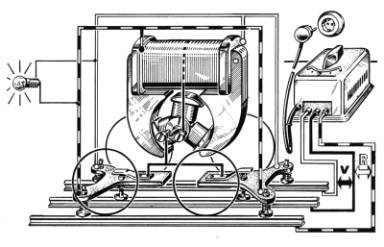
pioneered a unique 3-rail AC system designed to reliably solve the problem of
remote reverse switching. Instead of just the middle rail, all three were
insulated therefore all vehicles had to have phenoplast insulating wheels. The
locomotives had two sprung mushroom-shaped pick-up shoes for each rail, six
in total. The central rail was always the earth, while one of the outer rails
was assigned to forward running of the special 24V AC motor that had a split
field coil, one half for each direction, and the other to backward. Later models
such as the 0-6-0 T55 had 18V motors. Thus Zeuke found an elegant and absolutely
reliable solution for remote reverse switching, free from the previously common
problem of unwanted reversing if the power is accidentally interrupted e.g.
while going over the points [Udo Becher, Werner Reiche, ‘Bodenläufer,
Spielbahn, Supermodell’, Leipzig 1981, pp. 168]. The only disadvantage was
aesthetic: the phenoplast wheels were rather a drab brown, especially
unfortunate when compared to the bright red ones of actual trains.
|
|
|
|
Layout of the Zeuke 3-rail AC system [from U. Becher,
W. Reiche] |
|
|
|
|
|
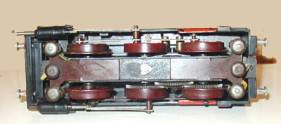
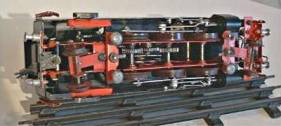
Zeuke 3-rail system with three insulated rails: Left
the Zeuke T55 0-6-0 tank locomotive, Right the BR 64 2-6-2 tank locomotive
(pick-up shoes for the central rail missing). |
|
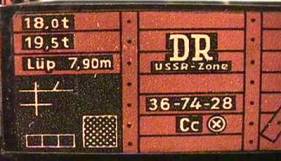
Zeuke made
also a wide range of tinplate rolling stock with full-size transfers were often
used for lettering and to provide additional detail such as the wood panelling
of goods wagons. The couplings were automatic, but in my judgment much more
functional and handsome than the Hornby version. Railway accessories included
light and semaphore signals with stop rails, a splendid signal bridge,
electromagnetic uncoupling track, and level crossings. Railway buildings were
made from plaster coated and painted wood. In 1955 Zeuke & Wegwerth bought
the entire O gauge production of the firm Stadtilm, and continued to distribute
or even produce portions of the range including the BR 64
The Zeuke
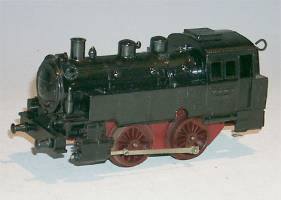
3-rail locomotives that I know of are:
·
Steam
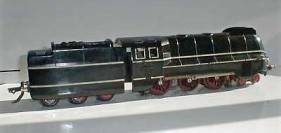
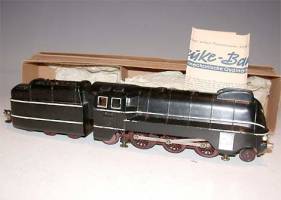
streamliner ‘F 50’, modelled after the BR 03.10 ‘Borsig’, in
·
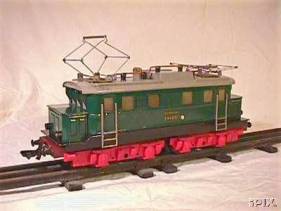
Electric
locomotive E44 with a tinplate body but a plastic roof. The 1-B-1 wheel
arrangement is cleverly disguised as Bo-Bo.
·
·
0-6-0
steam tank locomotives
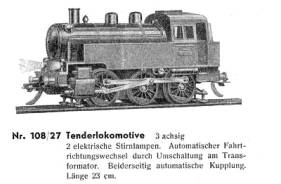
T48
(2 domes), and T55 (3 domes).
·
0-4-0
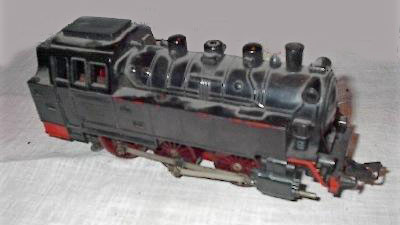
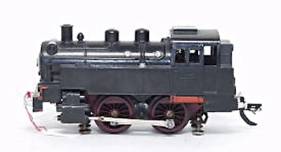
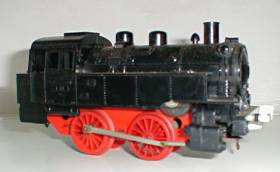
steam tank locomotive T48.
Their
rolling stock included Bakelite passenger bogie coaches, plus a large variety of
tinplate passenger and goods wagons:
·
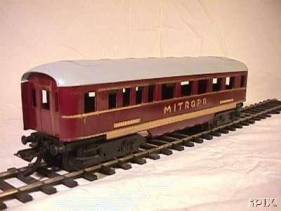
Bakelite
8-wheel ‘D-Zug’ express coaches, including a MITROPA dining coach
·
Tinplate
4-wheel passenger coaches (‘Donnerbüchse’ – blunderbuss)
·
Tinplate
4-wheel goods wagons e.g. refrigerator, wine, barrel and crane wagons.
|
|
|
|
F50 'Borsig streamliner, 4-6-0 version |
F50 'Borsig streamliner, 2-6-2 version |
|
|
|
|
T48 0-6-0 tank, Zeuke 1957 catalogue |
T55 0-6-0 tank |
|
|
|
|
T48 0-4-0 tank 3-rail |
Realistic full-size transfer on a goods wagon, note
'USSR-Zone' |
|
|
|
|
T48 0-4-0 tank, battery operated |
T48 0-4-0 tank clockwork |
|
|
|
|
E44 Bo-Bo electric |
Bakelite MITROPA dining coach |
Along with
its 3-rail model trains, Zeuke produced a line of toy trains with battery or
clockwork versions of the T48 Bakelite 0-4-0 tank locomotives, and also a line
of tinplate stock. The battery locomotives had a small 4.5V DC can motor and
bright red vinyl wheels with friction tires (that were more appealing than the
brown phenoplast wheels of the 3-rail and clockwork versions). The simple hook
couplings were not compatible with the firm’s own automatic couplings, and the
wagons had no buffers. Although the locomotives had reverse gear, the lack of
front couplings was disappointing on a tank engine. The 1961/62 catalogue
introduced two new battery-powered steeple-cabs ‘B60’, available as a diesel
or electric version with pantograph. They were Zeuke’s last O gauge
locomotives, now extremely rare because only a few were sold, and their thin
plastic shells broke easily.
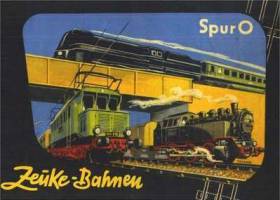
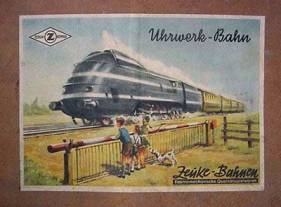
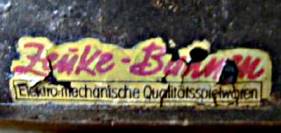
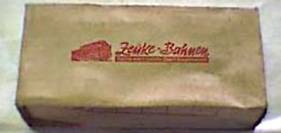
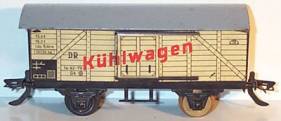
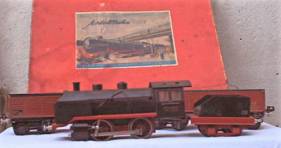
The pictures below show a catalogue, a box lid and the labels used on wagons and boxes. Also of interest are comparisons between the model and toy train ranges (refrigerator van), and between Zeuke and Liebmann designs e.g. for the passenger coach – the Zeuke tinplate coach with its embossed rivets and highlighted window frames is more appealing than the plain Liebmann aluminum coach.
|
|
|
|
Zeuke catalogue 1957 |
Zeuke clockwork set box lid |
|
|
|
|
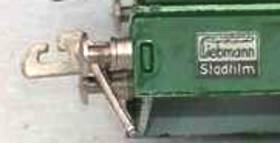
Zeuke label on underneath of wagon |
Zeuke trademark on box |
|
|
|
|
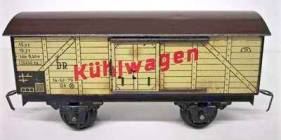
Zeuke Refrigerator van. Model range on the left with
buffers and automatic couplings, toy train range on the right with no
buffers and only hook couplings. |
|
|
|
|
|
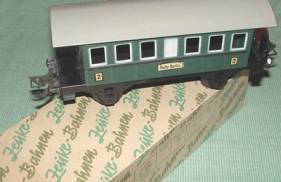
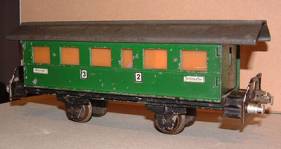
4-wheel passenger coach ‘Donnerbüchse’, Zeuke
(left) compared to Liebmann (right). |
|
When Zeuke showed their first TT-scale models at the 1957 Leipzig Spring Fair, it marked the beginning of the end of GDR O gauge. After 1961 Zeuke did not make any more 3-rail electric trains, even of the designs taken over from Stadtilm in 1955.
|
|
|
The last
battery-powered O gauge trains from the 1961/62 catalogue. |
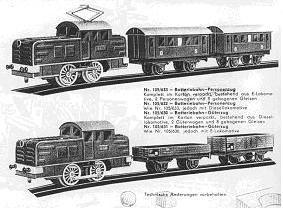
The
battery-powered toy train sets were still available for a few years until all
the resources were dedicated to TT. In 1972 the firm Zeuke & Wegwerth KG was
nationalised as ‘VEB Berliner TT-Bahnen’ after the state had supplied the
capital needed for new expensive injection moulding equipment. However the name
'Zeuke' had proved so popular it was kept in the trademark.
Liebmann / Stadtilm
The outbreak
of WWII halted the plans of Carl Liebmann
for producing an O gauge electric railcar 'Fliegender Hamburger', powered by his
newly developed small 24V DC can motor. Instead, he had to supply the motors to
power windscreen wipers on military vehicles and aircraft. In 1945 his firm Carl
Liebmann Metallwerke (= metal works) based in the Thuringian town of
In 1949,
shortly after the foundation of the GDR, the government decided to create a
‘GDR-Modellbahnindustrie’, a national model train industry. Successful
private enterprises were targeted for nationalisation. When the firm Liebmann
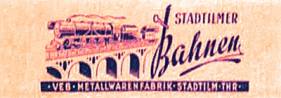
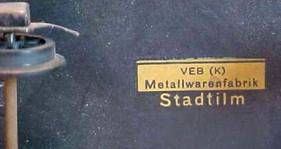
was nationalized in 1951 it became ‘VEB
Metallwarenfabrik Stadtilm Thüringen’ (VEB = state-owned factory, 'Metallwaren'
= hardware). Trains and boxes were labelled ‘Stadtilmer Bahnen’.
Defying the government's
stride towards standardisation, both Stadtilm and Zeuke kept their incompatible
couplings and 3-rail systems. However changes did begin to appear. Aluminium was
replaced by stamped steel, and plastic wheels were fitted to the
Below is a
list of trains that I seen up for sale on the Internet during the last 2 years
that were said to be made by Liebmann/Stadtilm:
·
Liebmann
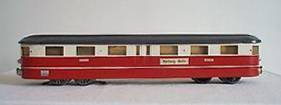
passenger bogie railcar "Der Fliegende Hamburger" No. 34 in red-crème
(designed in 1938)
·
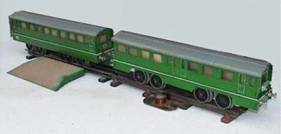
Liebmann
passenger railcar twin units, each coach 32cm long, about 1950.
·
Liebmann
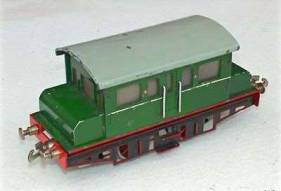
steeple-cab locomotive "E-Lok Nr. 38", known as "Bulli-Lok",
one of the earliest models, 20cm long.
·
Liebmann
0-4-0 goods locomotive and tender.
·
BR 01
(DR Baureihe 01)
·
Stadtilm
BR 64
·
Liebmann
'Gelenkzug', articulated passenger unit (two bogie coaches).
·
'Doppelstockzug'
- double-decker passenger unit with two or three coaches (69 or 98cm long),
modelled after the DR commuter trains.
·
A
large variety of four and eight wheel passenger, baggage, mail, and goods
wagons.
·
A
rather splendid twelve wheel crane wagon.
|
|
|
|
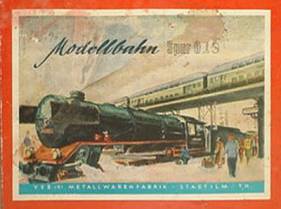
Liebmann box lid. |
Liebmann "Bulli-Lok" locomotive. |
|
|
|
|
Liebmann passenger railcar No. 34. |
Liebmann railcar twin unit (1950). |
|
|
|
|
Liebmann 0-4-0 goods set. |
Liebmann label, buffers and coupling. |
|
|
|
|
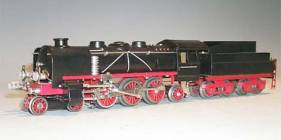
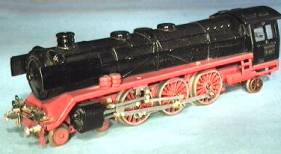
Liebmann BR 01 4-6-2 (45cm version). |
Liebmann BR 01 4-6-2 (51cm version). |
|
|
|
|
Stadtilm trademark on box. |
Stadtilm label underneath wagon. |
|
|
|
|
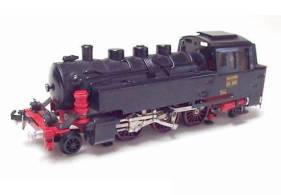
Stadtilm BR 64 2-6-2 tank. |
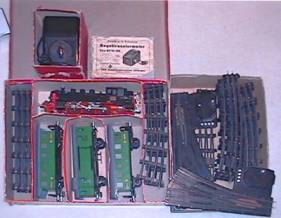
Stadtilm BR 64 passenger set. |
|
|
|
|
Stadtilm double-decker unit. |
Articulated unit ‘Gera–Greiz’. |
|
|
|
Liebmann passenger coach Photo courtesy of Hans-Peter Waak, Dresden, Germany |
Stadtilm twelve wheel crane wagon |
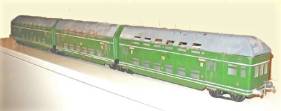
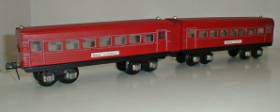
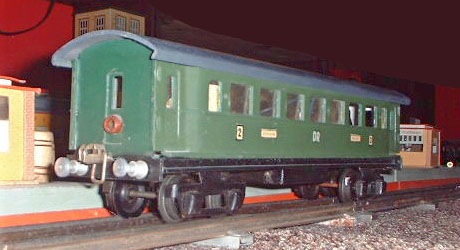
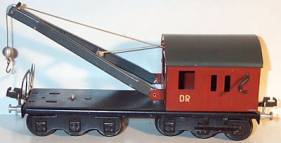
In 1955 Stadtilm stopped
making O gauge trains [Kurt Harrer, "Lexikon
Blechspielzeug" (Encyclopaedia of Tinplate Toys), Düsseldorf 1989, and
Dieter Käßler, "Die Baureihe 01 in Spurweite 0", Spielzeug Antik
Revue 1-2/2002, p. 20-22], and the
production was sold to Zeuke & Wegwerth. Possibly a portion of the O gauge
range was continued to be produced or distributed, and very few of the former
Stadtilm steam locomotives received original Zeuke mechanisms. These are now
rare oddities, making it rather difficult for the collector to differentiate
between Zeuke and Stadtilm without having the original box or a catalogue on
hand.
Between 1956
and 1964 VEB Stadtilm continued with a wide range of S gauge 2-rail DC electric
trains, featuring Bakelite locomotives and tinplate stock. Many passenger and
goods wagons were actually exact S gauge versions of the former O gauge items.
Thus the 'Doppelstockzug' re-appeared in S gauge.
|
|
|
Stadtilm
S-gauge coach |
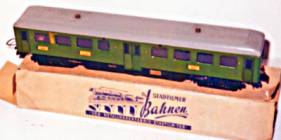
It is not known what role, if any, the firm VEB Metallspielwaren Weimar played in the O gauge field. After Stadtilm stopped producing S gauge in 1964, this firm continued S gauge with clockwork toy train sets in mixed tinplate-plastic construction, which were still available throughout the 1980s. One of the earlier sets featured a double-decker unit with steam locomotive.
Epilogue
My formative years as a
model railway enthusiast coincided with Zeuke’s transition from O to TT. At
the age of five I found a Zeuke O gauge goods set under the Christmas tree,
complemented by a passenger set the following year. Each sported the T48 0-4-0
battery powered tank locomotive and three wagons. I recall how the locomotives
run swiftly, smoothly and silently. However the lack of front couplings on tank
locomotives was disappointing, since the double heading required by longer
trains on uneven floors called for homemade wire couplings. The Bakelite buffers
did often not survive train accidents, but Zeuke once sent a new shell in
exchange for the broken one! I still remember the most
magnificent O gauge floor layout of Herr Oskar Fröb,
the retired owner of the ‘Erste Oberländische Dampfbierbrauerei’ (First
Highland Steam Brewery) of Lobenstein, my Thuringian hometown. The awesome sight
made me write already discontinued items,
such as a baggage van, crane wagon, bogie tanker, or buffer stop on my Christmas
wish list. Even with the help of the local toy shop owner, my father only
managed to come up with the last two from left-over Zeuke and Stadtilm stock.
This was as far as his involvement went. I felt fortunate that my father was one
of the few in the world who kept out of day-to-day toy train operation. With
hindsight I realise that he must then have got so fed up with the acquiring
adventure that he decided to switch me over from O to TT. I sold my O gauge
trains and spent the next decade with TT. Later O gauge started all over again
with an inherited soapbox full of Märklin – but that is another story.
Dirk Hertel (TCS 694)
Quincy, MA, USA.
May 18, 2003
Update
September 2003! Also look at the web site Lokfotos
with a congregation of all 3 versions of the Liebmann 4-6-2's.
‘Any make, Any gauge, Any age’
TCS©2009