 The
Train Collectors Society
The
Train Collectors Society
‘Any make, Any gauge, Any age’
Dirk Hertel writes
"In
mid-November I re-created the big clockwork floor layout that three years ago
was the origin of my article ‘Main Spring’ for the TCS News.
Again
the rails stretched over 3 rooms, featuring a large loop with the main station,
and a branch line leading to a terminus. The branch line was linked to the main
line via a triangle that allowed the trains to return to the terminus after one
or more rounds. The theme was passenger services in the time of the amalgamation
of the old railway companies into the Big Four, which made for interesting
combinations of locomotives and rolling stock by Bing, Bassett-Lowke, Märklin,
Carette, Hornby, Karl Bub and ACE. Station buildings by Bing and Karl Bub, a new
ACE platform, Basset-Lowke signals, Silver Crane house tins, tunnel, viaduct,
and a reproduction of the Carette water tower provided the ambience.
I had invited Lew Schneider, Dave Pitts, Stephen Gilligan (who is the author of the North American Hornby Society’s website) and his son David, who all brought their own clockwork trains. Lew and Dave brought some Bing and Hornby, and Stephen’s Hafner and Marx trains gave the event an American flavour. My clockwork-powered electric locomotive with 6 coaches by Märklin from its 1930s Reichsbahn period represented German-outline trains. In the tradition of British train get-togethers, I had provided tea, sandwiches and scones. Such reinforcement proved necessary because running a complex clockwork layout is not only great fun, but also requires wrist power, due consideration in train assembly and ‘timetabling’, and above all keen attention at the points.
Whereas
small locomotives usually need a full winding to get going, it turned out that
larger clockwork locomotives, for instance Bing George The Fifth, could be wound
only to the exact amount needed to take the train from station to station. This
required a bit of trying out so that the train neither runs out of steam
somewhere in the countryside, nor whizzes by the platform, leaving the
passengers stranded. This mode of operation promised to be much more rewarding
than just letting the trains run around in circles, and might spawn a future endeavor.
The quality of the rolling stock wheels plays a decisive role in the running of clockwork trains, and here the Märklin wheel sets, thanks to their profiles, thick axles and precise engineering proved to be unsurpassed in ease of running and dependability. As before, matching available clockwork power with an appropriate train load was key for running a successful operation.
The
Sunday afternoon went far too quickly, and all that remained of the layout are
lots of photos, some of which I selected to share with fellow TCS members."
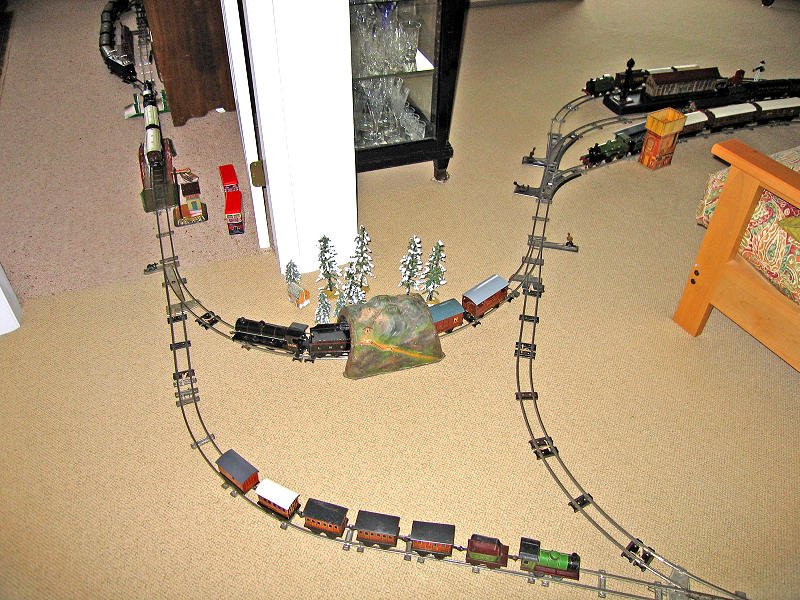 Overview of the layout, with the triangle in the foreground, terminus on the
left, and main station on the right.
Overview of the layout, with the triangle in the foreground, terminus on the
left, and main station on the right.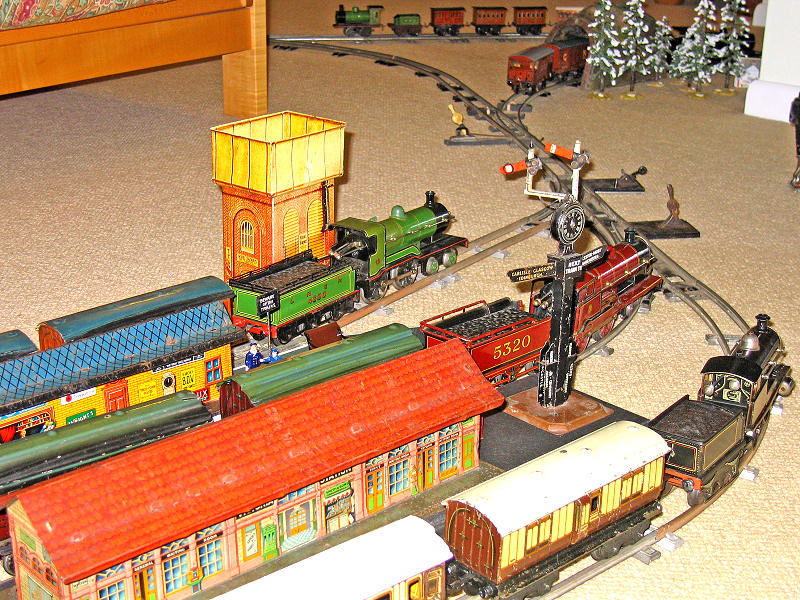 Three passenger trains ready for departure from the main station.
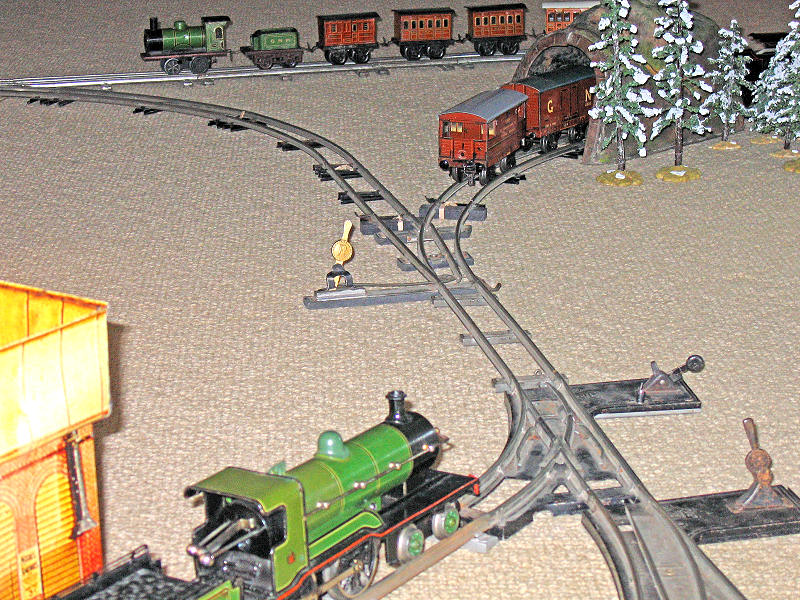 Setting the points correctly before departure is paramount for train safety!
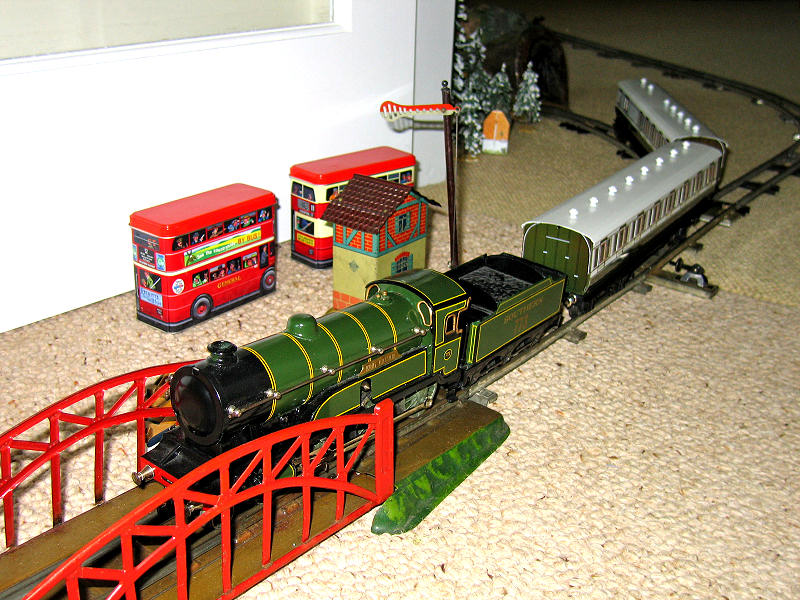 Bing SR 4-6-0 King Arthur with a rake of ACE LB&SCR coaches approaching the
viaduct.
Bing SR 4-6-0 King Arthur with a rake of ACE LB&SCR coaches approaching the
viaduct.
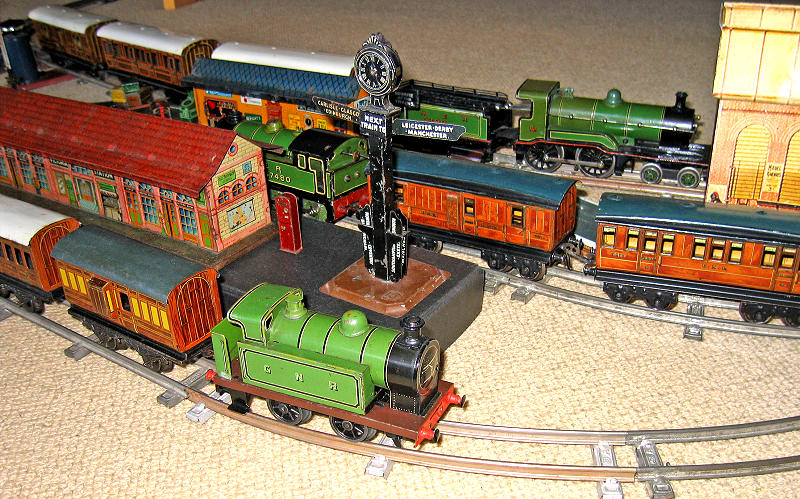 GNR and LNER trains, Carette GNR Greenly tank with Karl Bub coaches, Bing LNER
0-6-0 tank with Marklin 2873-2874 coaches, and Bing LNER 4-4-0 ‘D1’ with
Bing coaches.
GNR and LNER trains, Carette GNR Greenly tank with Karl Bub coaches, Bing LNER
0-6-0 tank with Marklin 2873-2874 coaches, and Bing LNER 4-4-0 ‘D1’ with
Bing coaches.
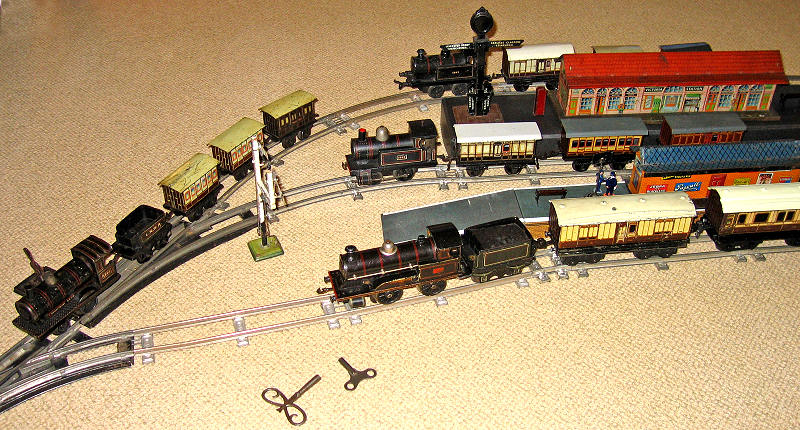 Three pre-1914 Bing LNWR trains, and a Marklin for Gamages ‘Queen Mary’
train from the 1920s.
Three pre-1914 Bing LNWR trains, and a Marklin for Gamages ‘Queen Mary’
train from the 1920s.
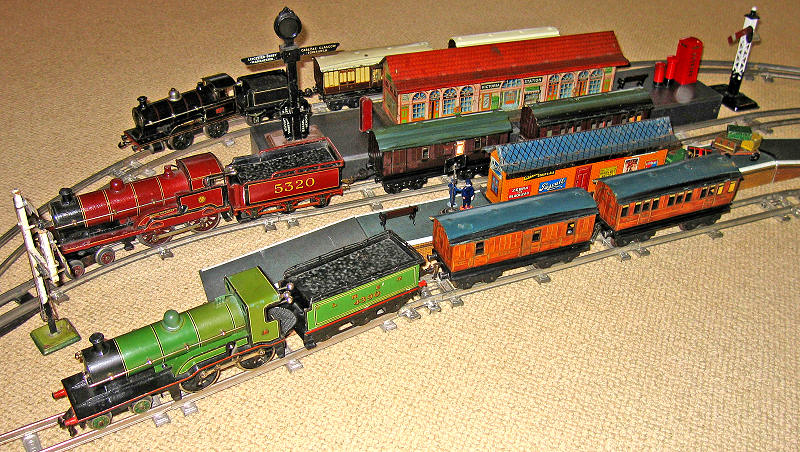 Marklin for Gamages coaching stock in all 3 available pre-grouping liveries, GNR,
Midland and LNER, headed by matching Bing and Marklin locomotives.
Such mixed trains were actually shown in the Gamages 1913 Christmas Bazaar
catalogue.
Marklin for Gamages coaching stock in all 3 available pre-grouping liveries, GNR,
Midland and LNER, headed by matching Bing and Marklin locomotives.
Such mixed trains were actually shown in the Gamages 1913 Christmas Bazaar
catalogue.
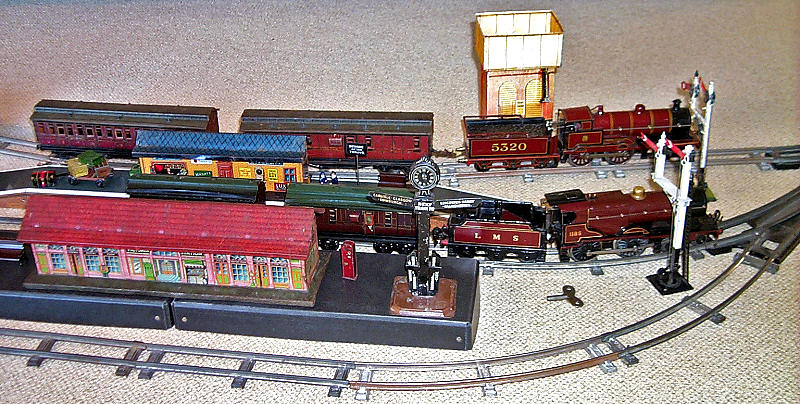 Midland coaching stock by Marklin and Carette, with Hornby LMS 4-4-0 Compound,
and Bing for BL LMS 4-4-0 George The Fifth.
Midland coaching stock by Marklin and Carette, with Hornby LMS 4-4-0 Compound,
and Bing for BL LMS 4-4-0 George The Fifth.
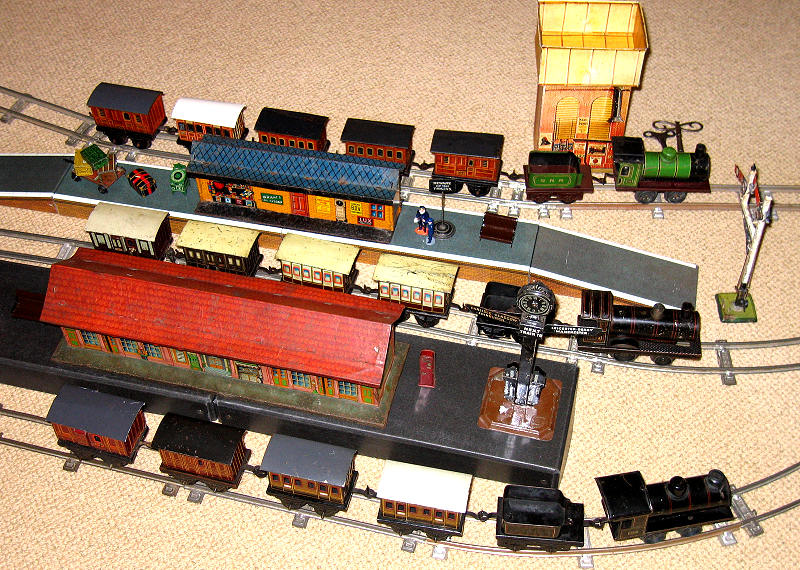 A congregation of Bing 2-compartment coaching stock, in the liveries of the
L&Y, LNWR, and GNR.
A congregation of Bing 2-compartment coaching stock, in the liveries of the
L&Y, LNWR, and GNR.
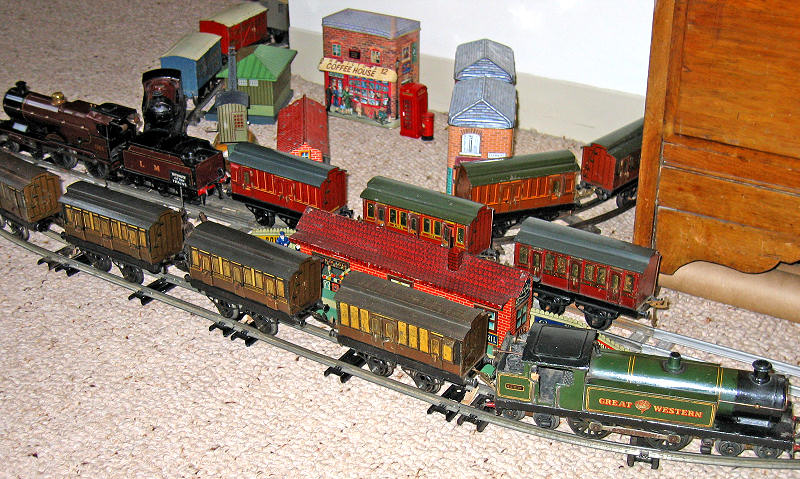 Terminus with early Hornby clerestory passenger trains in GWR, LMS, and LNER
liveries
Terminus with early Hornby clerestory passenger trains in GWR, LMS, and LNER
liveries
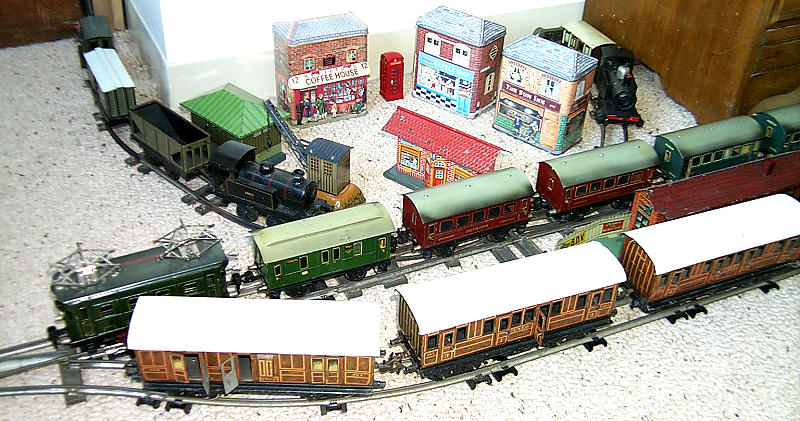 The Marklin Deutsche Reichsbahn electric outline passenger train arrives at the
terminus.
The Marklin Deutsche Reichsbahn electric outline passenger train arrives at the
terminus.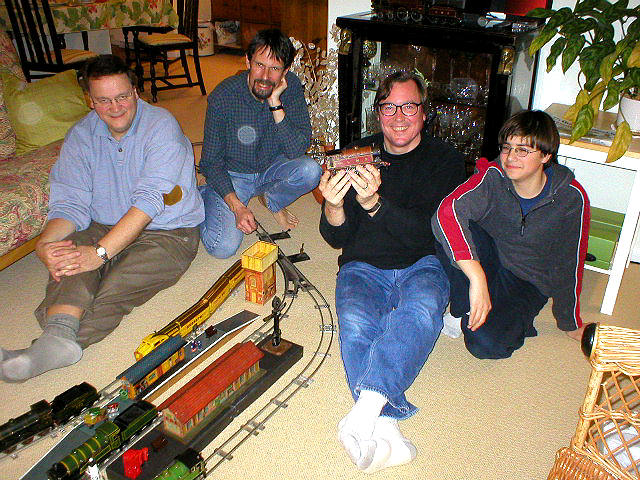 The Quincy
windup crew, Dave Pitts, Dirk Hertel, Stephen and David Gilligan (from left -
this photo was taken by Lew Schneider)
The Quincy
windup crew, Dave Pitts, Dirk Hertel, Stephen and David Gilligan (from left -
this photo was taken by Lew Schneider)
{All
pictures apart from the last are by Dirk Hertel, to whom many thanks for this
feature)
‘Any make, Any gauge, Any age’
TCS©2009