 The
Train Collectors Society
The
Train Collectors Society
‘Any make, Any gauge, Any age’


BRITISH MARX
The 0 gauge tinplate toy trains: a review
By Paul Williams
British Marx? Didn't they make the Silver link? So goes the usual conversation..... and yes they did, and most evocative it is too! British Marx trains have been largely ignored by both writers and collectors, and that, together with their unusual and distinctive style, and a scarcity of examples, have gained them an air of mystery and speculation. Here I draw together the limited strands of information. In my search for the evidence,! am indebted to Bill Marston in England and Walt Hiteshew in the USA, both Marxmen through and through. Bill produced a copy of an article written in 1997 for the Classic Toy Trains magazine by the late lan Paterson and both have given valuable information, and were kind enough to review these notes. From around 1920 Louis Marx started to produce his range of toys in the USA, with his first 'Joy Line' mechanical (clockwork) train set appearing in the 1927 Sears mail order catalogue. His trains were sold under the Joy Line brand until the 1934 to 1936 period, when the new 6 inch tin series, that was to begin a complete system and continue into the 1970's, was introduced together with the new and very distinctive Marx style and branding. Trains were sold in sets, as individual items, and there was a wide range of accessories, with track systems in both 27 and 34 inch radius. According to research done by lan Paterson, we know Marx had already established a factory in Dudley, England in late 1931, with limited production of USA style trains for sale in the UK. Coinciding with the switch in the USA to the new range, Marx introduced to the UK a range of trains closely based on the USA styling, and using some of their tooling. As WW2 progressed, the Dudley factory switched to war production, and did not open again for toy production: in 1948 all work was transferred to a new factory in Swansea, Wales. Despite the success in the USA, it is apparent that expansion was never fully realised here, the UK being limited to boxed sets with no supply of accessories other than extra track, a crossover and points . The USA production is well documented in the three Greenberg guides, and a 4th volume of catalogues; in the reprints of the Sears and Montgomery Ward mail order catalogues, and in many preserved examples of trade brochures, original catalogues and instruction sheets. Here in the UK it is exactly the opposite; no brochures, trade information, catalogues or reference material of any kind, with the exception of a few trade adverts. Eric Matzke, writing the Greenberg's guide to Marx trains, makes but four brief references to the UK trains, quoting only anecdotal evidence from conversations with former employees. I have been able to find only two references to British Marx trains in the many books on the topic in general. Various works considered as standard reading on the history of toy trains are strangely silent, almost as if the writers had no knowledge that British Marx existed. In addition to the Greenberg book, the other is in 'The Collectors Guide To Toy Trains' by Ron McCrindle. He gives us little information except to include a picture of the Silver Link set, and notes it was available around 1936. He does add that like Marx's products in the USA, the British trains were chiefly marketed through the cheaper chain stores, and comments on the coaches being reminiscent of the NYC.. ...well he might, as it is apparent they are from the same pressings. Fortunately we have two further sources. In 1997 the late lan Paterson wrote an article for the Classic Toy Trains magazine, and Walt Hiteshew has a website with excellent photos and information; both of these sources are an invaluable reference. As with other manufacturers of the period, we can make a distinction between the trains of pre and post World War.
Continued in the Magazine
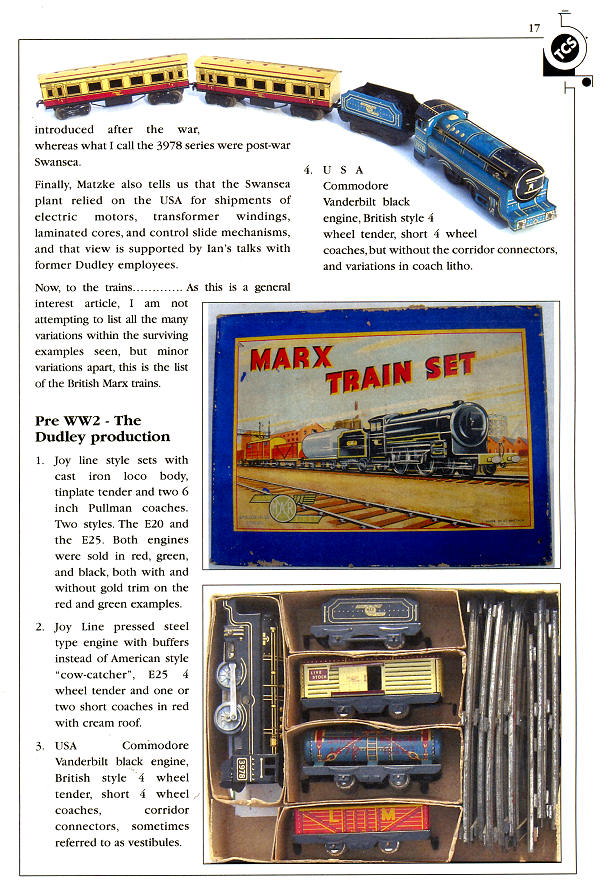
Page 3 of Paul's article
‘Any make, Any gauge, Any age’
TCS©2009